What is EIS?
The Enterprise Investment Scheme (EIS) is a government-backed tax relief scheme. It was designed to encourage investment into small, high-risk and often knowledge-intensive companies by individual private investors, by providing them with both income tax relief and capital gains tax (CGT) relief (in the form of deferral relief and disposal relief).
These EIS tax incentives, along with the Seed Enterprise Investment Scheme (SEIS), help support the United Kingdom’s early-stage businesses, providing loss relief for early-stage investors and better access to growth capital for qualifying companies.
The latest trends in EIS uptake
Whilst Beauhurst tracks every equity investment into the UK’s private startups and scaleups, we usually don’t know the tax status of the individuals involved in those deals. Even if the recipient company is EIS-eligible, it’s impossible to tell, for example, whether an investor received EIS income tax relief on a particular investment, whether they had used up their investment allowance for the tax year, or if they’re not even a UK taxpayer. For these reasons, HMRC’s official data are useful firstly to understand the popularity of EIS.
We’ve previously analysed the last two years of HMRC’s official data on EIS and SEIS. In last year’s article, we were disappointed to find that both the number of companies using EIS and the amount raised via EIS had fallen, compared with the previous tax year, even if the falls were relatively modest.
How many companies used EIS in 2020?
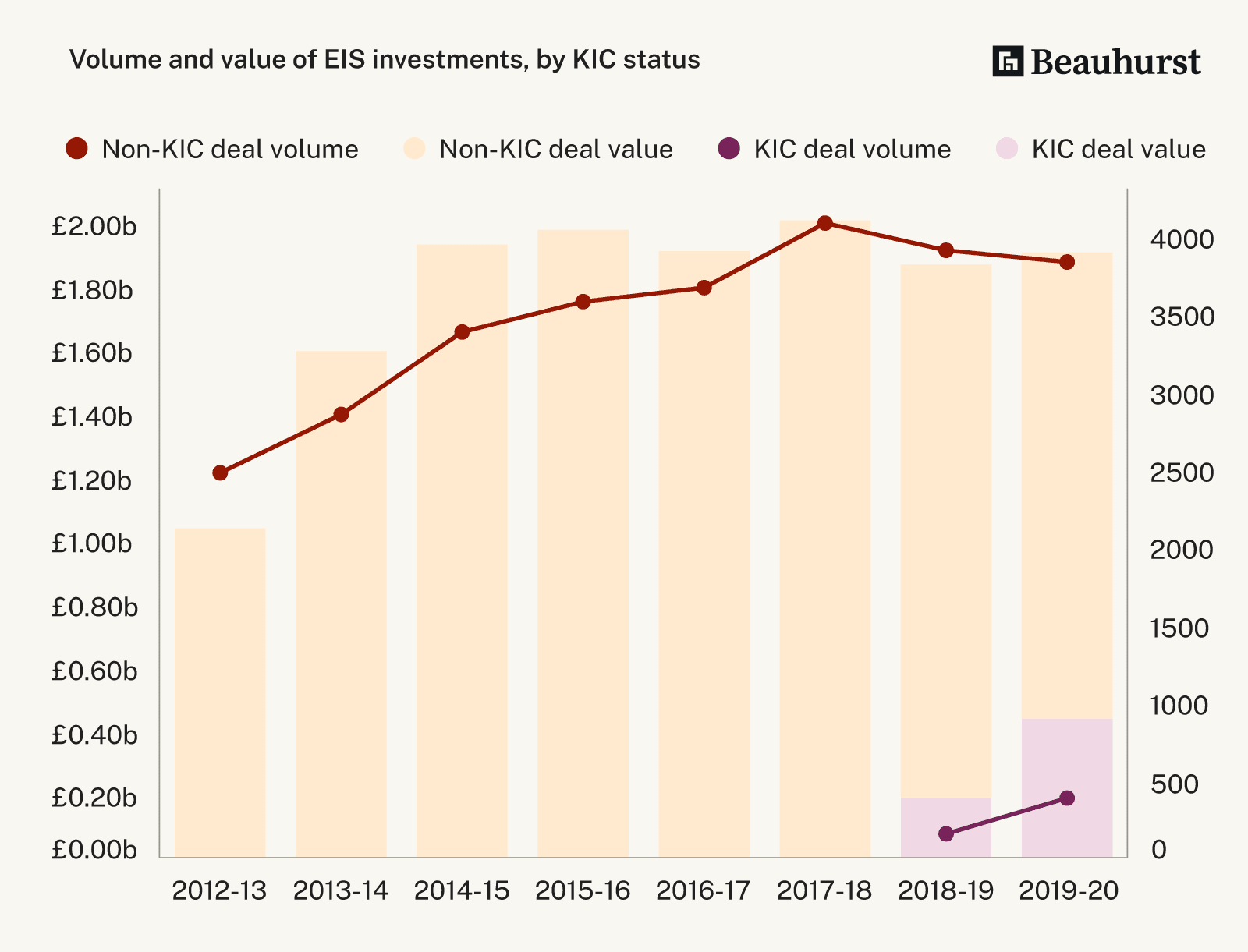
Pleasingly, the latest set of EIS statistics allow us to paint a rosier picture. The number of companies raising EIS has increased by 4% and the amount raised through EIS shares has grown by 2%.