If you’ve ever tried to build a target list using SIC (Standard Industrial Classification) codes, you’ll know the feeling.
You search for a sector, get back a list of hundreds or thousands of companies, and spend the next few days manually cutting it down to the ones that actually matter. Or you search for a sector that barely existed when the classification system was written, and get almost nothing back.
The UK’s Standard Industrial Classification system was last meaningfully updated in 2007, and the economy has moved on a long way since then. For anyone doing business development, origination, or sector research today, SIC codes are often too broad, too outdated, or both.
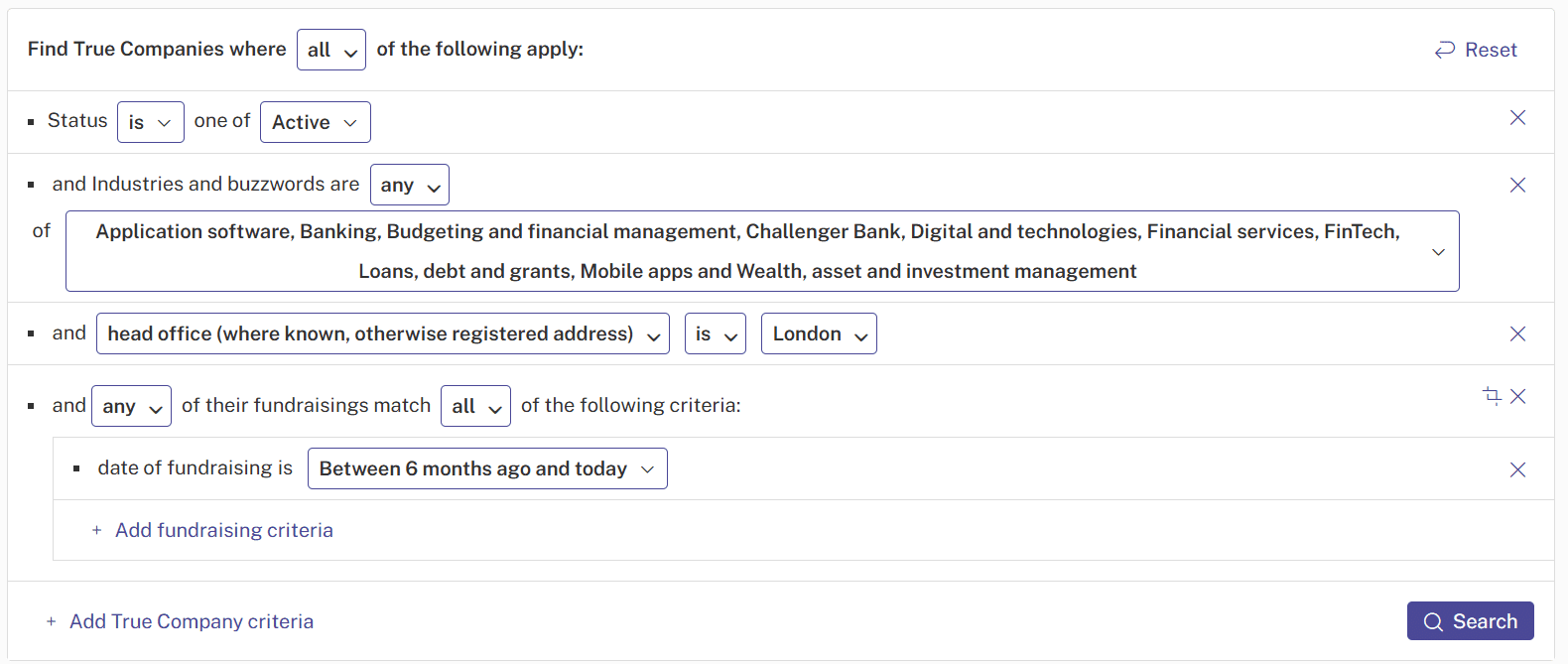
This article explains why SIC codes fall short, what that costs teams who rely on them, and how to find the companies you’re actually looking for, including a walkthrough of how Beauhurst’s live industry classification works in practice.
What SIC codes are and why they still get used
A quick recap of SIC 2007
The UK Standard Industrial Classification (SIC) system assigns every registered company a code describing its main area of business activity. Companies choose a SIC code, sometimes several, when they incorporate at Companies House, and that code becomes part of the public record. The current version, SIC 2007, groups businesses into sections, divisions, groups, and classes, running from broad categories like ‘Information and Communication’ down to specific activities like ‘62012, business and domestic software development.’
Where SIC codes still add value
The UK Standard Industrial Classification (SIC) system assigns every registered company a code describing its main area of business activity. Companies choose a SIC code, sometimes several, when they incorporate at Companies House, and that code becomes part of the public record. The current version, SIC 2007, groups businesses into sections, divisions, groups, and classes, running from broad categories like ‘Information and Communication’ down to specific activities like ‘62012, business and domestic software development.’
Why SIC codes are outdated and too broad
A 2007 taxonomy in a 2026 economy
SIC 2007 is nearly two decades old, and it shows. Entire sectors that are now significant sources of deal flow and investment, such as agritech, generative AI, climate tech, quantum computing, and insurtech, don’t have dedicated codes. And whilst SIC 2026 is just around the corner, the government has not yet mandated the use of these.
Companies operating in these spaces get scattered across loosely related buckets, or lumped in with businesses that have nothing in common with them beyond a shared four-digit number.
Generic categories bundle very different businesses
Even within long-established sectors, SIC codes group together companies that a human researcher would never put in the same bucket. Code 62012, for instance, covers everything from a consumer mobile app studio to an enterprise SaaS provider to a defence software contractor.
If you’re trying to build a target list of mid-market enterprise software companies for outreach, a SIC-based search hands you all three, and you’re left working out manually which ones are actually relevant.
The "Other" and "not elsewhere classified" black hole
Every SIC section has a catch-all: ‘Other,’ ‘not elsewhere classified,’ or similar. In practice, these codes absorb a large number of companies, often the innovative, hard-to-categorise businesses that are most interesting to origination and investment teams. Once a company lands in ‘Other,’ it’s effectively invisible to anyone searching by SIC code. You’d need to already know it exists to find it.
Self-selection and stale codes
Companies choose their own SIC code at the point of incorporation, and there’s little incentive to update it later. A business that pivots from consumer app to B2B platform, or from services to product, will often keep the SIC code it registered with years earlier. So SIC data frequently describes what a company was on day one, not what it does now.
Emerging sectors that don't fit anywhere
Fast-moving, cross-disciplinary industries (think climate-adjacent manufacturing, decentralised finance, or synthetic biology) are exactly where SIC classification breaks down, which is a particular problem for anyone whose job is to spot opportunities early.