
Bridging the UK's North-South Investment Divide

Words Callum Newton

Bridging the UK's North-South Investment Divide

Bridging Britain’s investment North-South divide

Last month the Chancellor announced the Government’s new Northern Growth Strategy. As a northerner, we are used to periodic strategies (from both sides of the political divide) promising to revive communities, reverse some of the damage of deindustrialisation and generally take us back to the “good old days”. Meanwhile UK economic growth continues to be concentrated in the capital and surrounding Home Counties.

But this strategy is unusually frank. Northern productivity sits 25% below London and South East England, almost exactly where it was two decades ago. The strategy leads with claims that “too often” local leaders “have not been sufficiently backed by central government – with pepperpot funding, empty slogans or false promises on investment infrastructure”. It’s a striking admission and attempts to increase the “historically low levels of business investment” into the North is a central pillar of the Government’s strategy.

If the litany of other post-war strategies has taught us anything, it’s that public money alone won’t bridge the North / South divide and private investment into businesses is crucial to catalysing growth. With that in mind the Beauhurst Insights team wanted to ask a simple question: over the decade in which “Levelling Up” and the “Northern Powerhouse” dominated the policy conversation, how much private investment actually found its way North?

The North-South equity investment gap

Much has been said about Britain’s North / South divide, but one stat sums up the difference quite neatly. Between Q1 2015 and Q4 2025, private businesses across the North East, North West and Yorkshire & Humber secured £21bn in equity funding from investors. This sounds impressive. But to put this in perspective this figure is smaller than the sum secured by firms within a single London Borough. Over the same period, private firms operating within Westminster City Council secured £33bn.

Some people would be correct in saying Westminster is an edge case, but over the measured period London’s businesses secured over six times more investment than their Northern peers. The Northern Growth Strategy itself notes that total business investment per job in the North West runs at £9,200, against £13,000 in London. That gap, on the government’s own framing, is bad enough. The deal-flow gap is wider still, and it sits in exactly the part of the economy the strategy says it wants to grow: scale-ups (often equity back), innovation clusters and the high-growth sectors at the heart of the Industrial Strategy.

The Westminster comparison is striking, but the trend over the decade is even more telling. Despite the Northern Powerhouse and Levelling Up agendas, last year Northern England raised around the same level of investment as the region did a decade earlier. As shown in Figure 1, the gulf in the value of completed deals between the North and South has grown substantially over the last decade, from around £1.7bn in 2015 to over £4.3bn in 2025. Put simply, Northern businesses get fewer deals, lower investment and have to give up larger equity stakes than Southern peers.
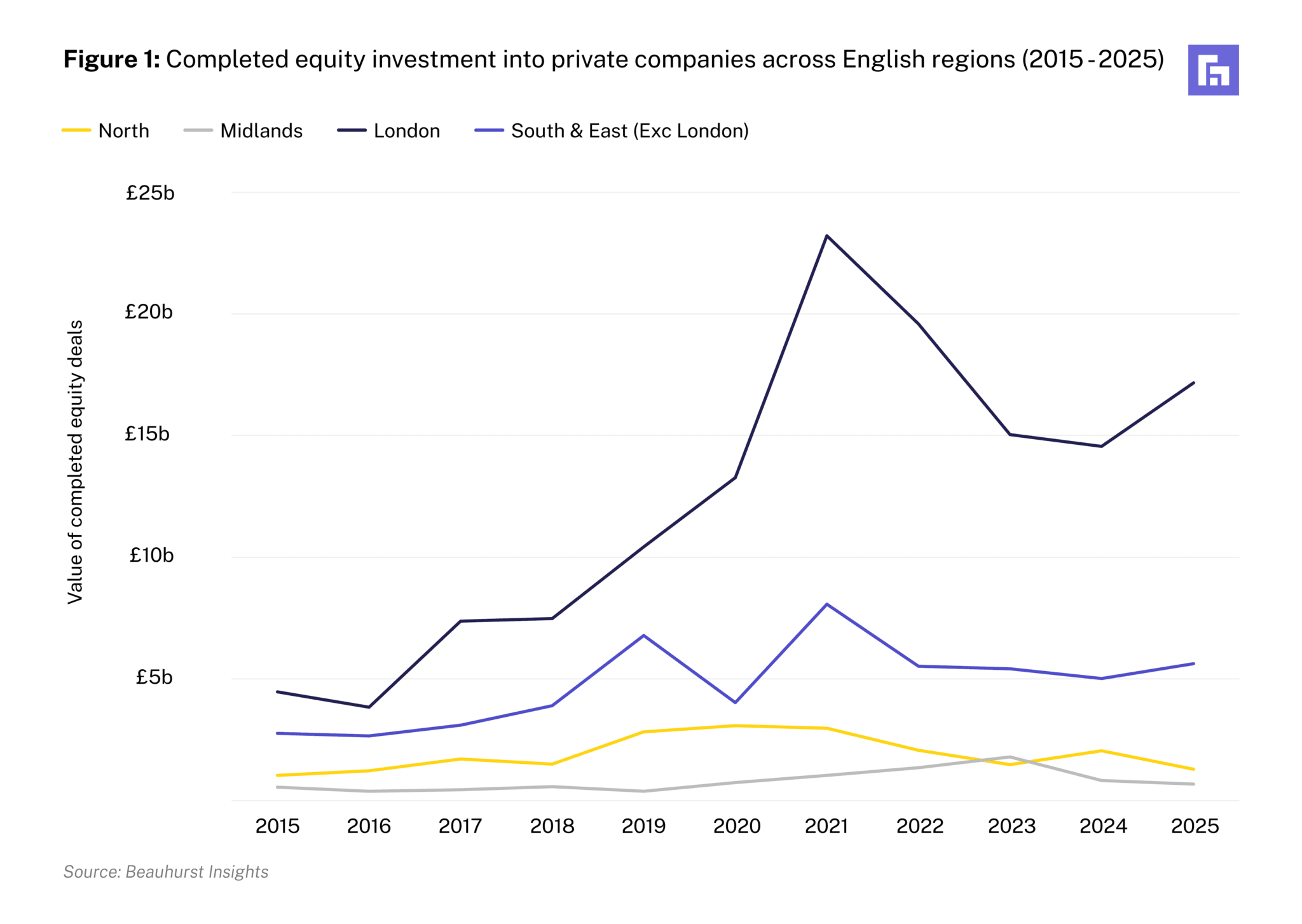
line chart 1

Why Manchester leads Northern investment

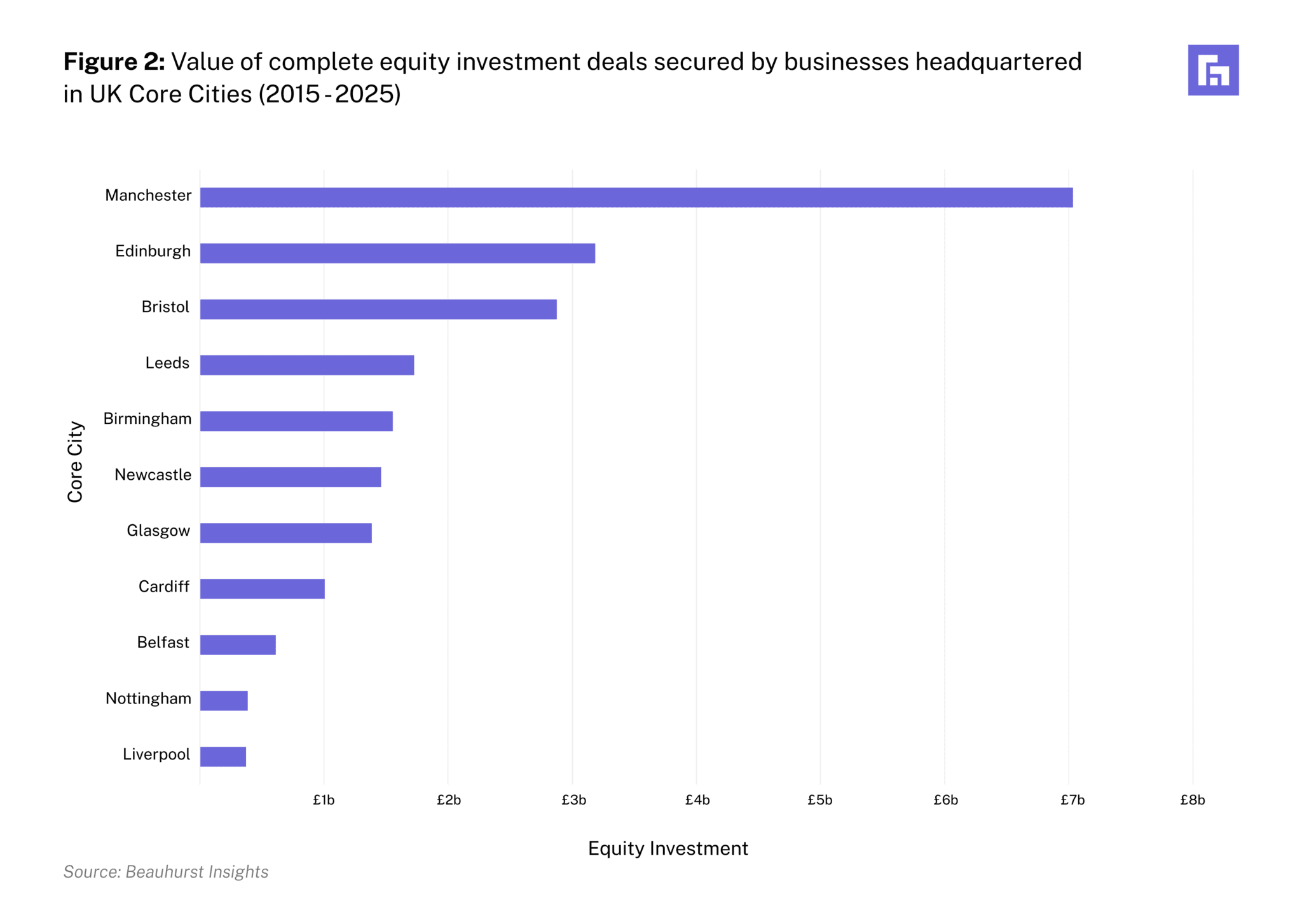
There is one bright spot, and the strategy knows it. The ‘Case for Change’ notes that Sheffield and Newcastle have grown twice as fast as the UK average since 2019, and Manchester four times as fast. On equity-deal flow, that pattern is even sharper: Manchester alone accounts for one-third of all investment raised by Northern companies between 2015 and 2025. Even amongst its Core City peers, it would be an understatement to say Manchester is first amongst equals. The city accounted for 32% of the total equity funding secured by Core Cities nationally over the last decade, including more than Liverpool, Leeds, Sheffield and Newcastle combined.

bar chart 1

Manchester is a success story of post-industrial revival which should be emulated across the region. At the centre of this success is the influx of private capital, which has done much of the heavy lifting in terms of fuelling Manchester’s economic turnaround. The Northern Growth Strategy explicitly credits Greater Manchester as the pioneer of the MSA devolution model. The deal data backs that up. Something about the combination of mayoralty, university density, sectoral specialisation in fintech, life sciences and creative industries, and a decade of consistent local leadership has produced a venture ecosystem that the rest of the North has not been able to replicate (yet).

The ‘Northern’ venture story is, to a striking degree, the Manchester story. That is not a problem to dismiss; it is a model to learn from. If the strategy wants the rest of the region to look like Manchester, it needs to be honest about why Manchester works and to resist the temptation to spread the same pot thinly across cities that have not yet built the same foundations.

Closing the North-South divide: what the data shows

The diagnosis in the Case for Change is the most clear-eyed any UK government has offered on the North in years. The £40bn-a-year productivity prize is real and could be the key to getting Britain out of its current economic funk. Transport, devolution and town regeneration matter, and the strategy’s commitment to them is welcome.

But the strategy underweights the part of the economy that creates new firms – and the data on that part of the economy unfortunately appears to be going the wrong way. “Pepperpot funding” the Chancellor noted, hasn’t worked. On current evidence, the slogans of the past decade did not bend the curve. Manchester shows the model can work. The harder question for the new strategy is whether it is bold enough to copy it, fast enough to apply it and patient enough to wait for it to land.

Want to discuss the data? Drop me a message: callum.newton@beauhurst.com

Subscribe to the Beauhurst Insights Substack

Data-led analysis of the UK’s private companies, straight to your inbox.

Subscribe
Discover our data

Get access to unrivalled data on all the companies you need to know about, so you can approach the right leads, at the right time.

Book a demo today to see all of the key features of the Beauhurst platform, as well as the depth and breadth of data available.

An associate will work with you to build a sophisticated search, returning a dynamic list of organisations that match your ideal customer profile.