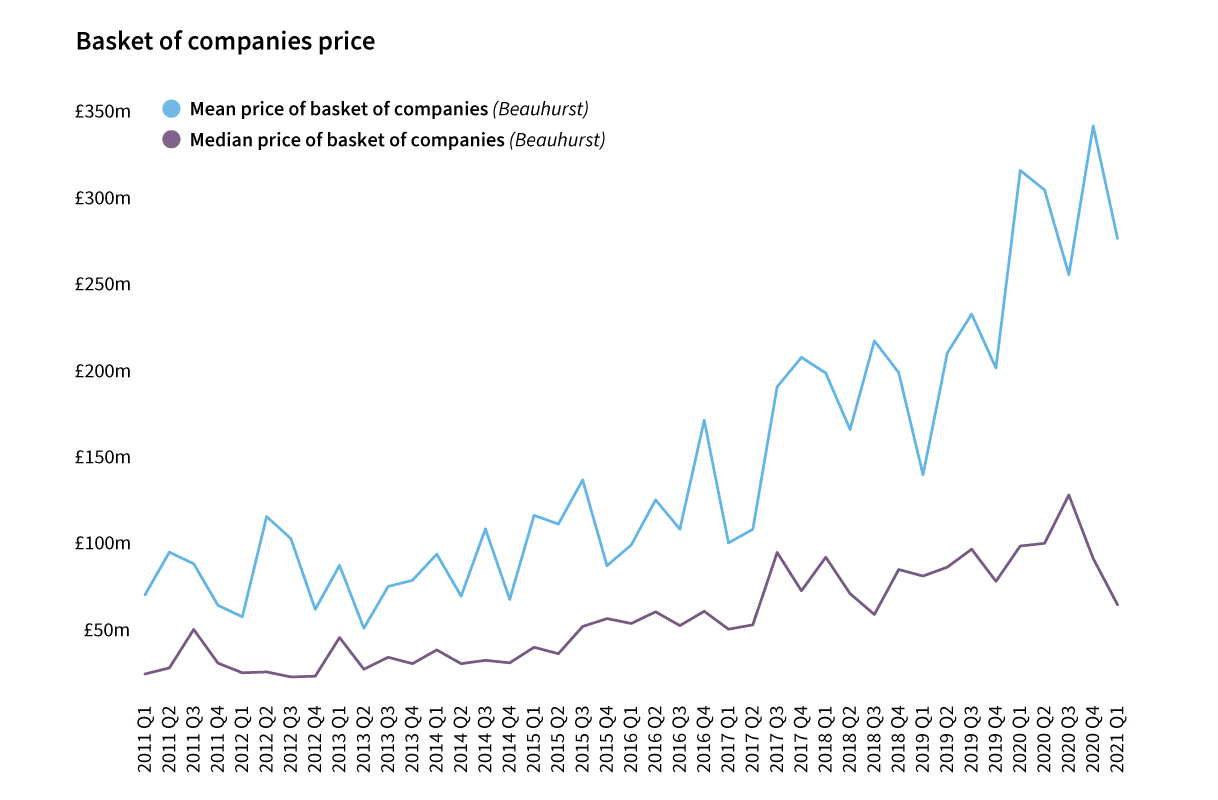
This article breaks down the methodology that has been used to calculate the changes in mean and median price over time and explores several potential contributing factors before outlining practical considerations for business leaders and investors. Leaders should seek out transactions at comparable companies to make sure they are getting valued at market rates. Investors are likely to have already noticed that they are paying more than they have previously; the influx of money into the asset class (and tech companies in particular) is also likely to have driven price-based competition. This is unlikely to go away any time soon.
Measuring company valuations over time
To analyse prices changes over time, the cost of a group of nine ‘average’ companies was calculated for the end of each quarter since 2011. The price of the companies has been calculated using both the mean and median company valuation by stage of evolution and sector over the quarter, based on equity fundraisings. Every quarter, the basket of companies consisted of an average-valued seed, venture and growth stage company in the technology, business and professional services, and industrial sectors. These sectors were chosen because they represent 88% of the total number of equity deals since 2011. Beauhurst has deep data on companies that have fundraised at the three growth stages selected, helping to ensure accurate pricing of the basket. This methodology—using a basket of ‘goods’—is also employed to calculate inflation.
Increased investment into the UK’s private companies
There was significant investment of £14.5b into the UK’s private companies in 2020, down slightly from the high of 2019, when £16.3b was invested. However, the full impact of the Future Fund is not yet accounted for in 2020, and the overall investment into UK private business may have been higher. Regardless of this, the rough trend since 2017 has been high annual investment in private companies via a declining number of deals. The first quarter of 2021 saw a record £6.4b invested, beating the previous quarterly record of £4.7b in Q2 2019. Naturally, as more money seeks fewer deals, valuations will rise.
Larger fund sizes
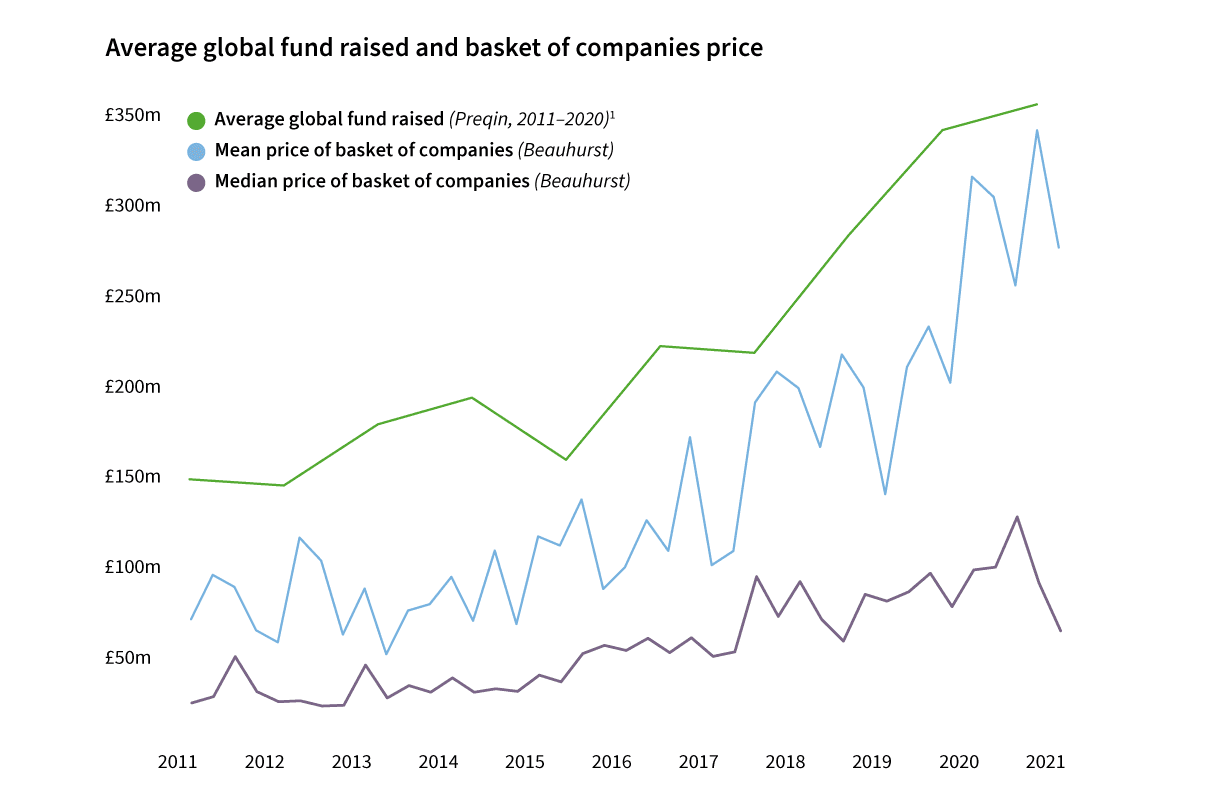
The average fundraising for a fund has increased every year from 2015. In 2015, the average fund raised was £149m, while in 2020, the average fund raised was £361m. The simple argument here is one we’ve heard before; a rising tide lifts all boats. More money for investments means prices will rise. Another subtler aspect may be that, as investors raise larger funds, it becomes more challenging from an administrative and behavioural standpoint to write smaller cheques. Even when investing in smaller companies than usual, a fund manager or VC may find it easier to agree to higher valuations and cut familiar-sized cheques.
With an effect like this in place, valuations for earlier rounds are shifted upwards, which then drives up valuations at later stages.