Corporate venture capital, or CVC, is a form of venture finance in which corporations are directly investing into private companies, providing growth capital as well as industry knowledge and corporate resources for product development. By acquiring equity stakes in these innovative businesses, CVC funds can gain a competitive advantage and access to new markets. In turn, this investment facilitates and accelerates innovation by pairing growth capital with industry knowledge and corporate influence.
A key driver of innovation in new markets, activity in the corporate venture ecosystem has grown dramatically in the last decade, with global corporate venturing reaching a record $73.1b in 2020, according to recent research by PwC and CB insights. Our own research also shows continued growth in the UK, with corporate giants from all over the world looking to UK startups for the next generation of new technologies.
In this article, we’ve compiled a list of the most active CVC investors in the UK, their investment philosophies, and the types of companies they’re backing. This ranking has been determined by the number of announced equity deals made into high-growth UK companies throughout the past decade. Although we track all equity fundraisings in the UK, we won’t know which funds have participated in a round unless it is announced to the public, so actual portfolio numbers may be larger where investments remain undisclosed.
How is Corporate Venture Capital (CVC) different from Venture Capital (VC)?
Before we get into the list, let’s first discuss the difference between corporate venture funds and traditional VC funds.
Corporate venturing is very similar to venture capital, as both involve investors backing external startup companies and entrepreneurs. But whilst the VC model is based around LPs (Limited Partners) and GPs (General Partners), corporate venture capital typically involves large companies acting as a single LP. They usually have specific venture arms that are managed by specialised divisions. Intel Corporation’s CVC investment fund, for example, is managed by Intel Capital.
Another key difference between VCs and corporate investors lies in investment objectives. Venture capital funds look for strong financial returns for their LPs, often through high valuations at exit events (IPOs, mergers and acquisitions). Whereas, CVCs have additional objectives to consider alongside ROI, such as technology exchange between portfolio companies, strategic partnerships, brand reputation, and getting ahead of new trends.
Venture arms at large corporations also differ to VC firms in their level of involvement in investee companies. VCs tend to seek greater control over their portfolio companies, typically providing guidance and follow-on investments, in exchange for a seat at the table.
UK corporate venturing trends over time
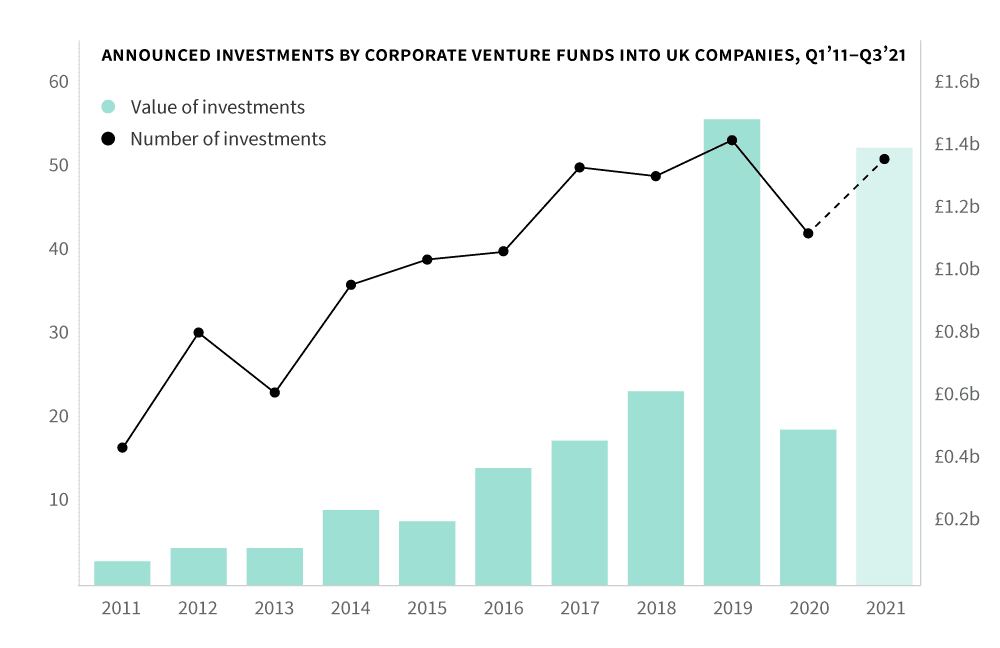
Since 2011, we’ve tracked 429 announced CVC deals into UK startups , with a value of £5.55b in total. This is in comparison to the lowest ebb of investment in 2011 in which there were 16 deals worth £17.1m.
There has been a particularly steep increase in the value of investment made in recent years, with a high of £1.5b in 2019. And whilst 2020 saw a predictable dip, mostly due to the impact of the Coronavirus pandemic, 2021 is already proving very strong, with 51 deals and £1.39b of investment recorded so far.
This growth is reflected across the globe as corporations seek new channels of growth. While the UK continues to be the powerhouse of CVC investment in Europe, other countries are also getting involved.