We need to talk about mid-market corporates (MMCs).
They’re a vital part of the UK’s business economy, contributing over 27% of the total turnover in the UK. However, unlike small and medium-sized enterprises (SMEs) and large corporates (LCs), mid-market corporates lack a clearly defined identity.
This ambiguity inevitably leads to misunderstandings on what MMCs actually are. More broadly, this crisis in identity means that MMCs benefit from fewer support schemes than SMEs and large companies.
In this article, we’ll explore the complexities behind defining MMCs and how — from an account management perspective — sleeping on company growth metrics can lead to lost opportunities as your SME clients transition into the middle market.
What is a mid-market corporate?
Ask anyone in business for a definition of a mid-market corporate and they’ll likely give you a different definition to the next person.
HMRC itself seems to define middle-market corporates in different ways, with a 2014 report defining a mid-size business as one with turnover between £25m and £200m per annum, with more than 20 employees. Meanwhile, its 2021 ‘mid-sized business customer survey’ — the latest of its kind — defines MMCs as “those with Corporation Tax or Income Tax Self-Assessment turnover of £10 million or more and/or more than 20 employees.”
It’s an admittedly slippery definition, but there is some consensus. Middle-market corporates tend to be defined (albeit loosely) via a combination of turnover and headcount.
For the purpose of this article, we’ll define MMCs in the following way:
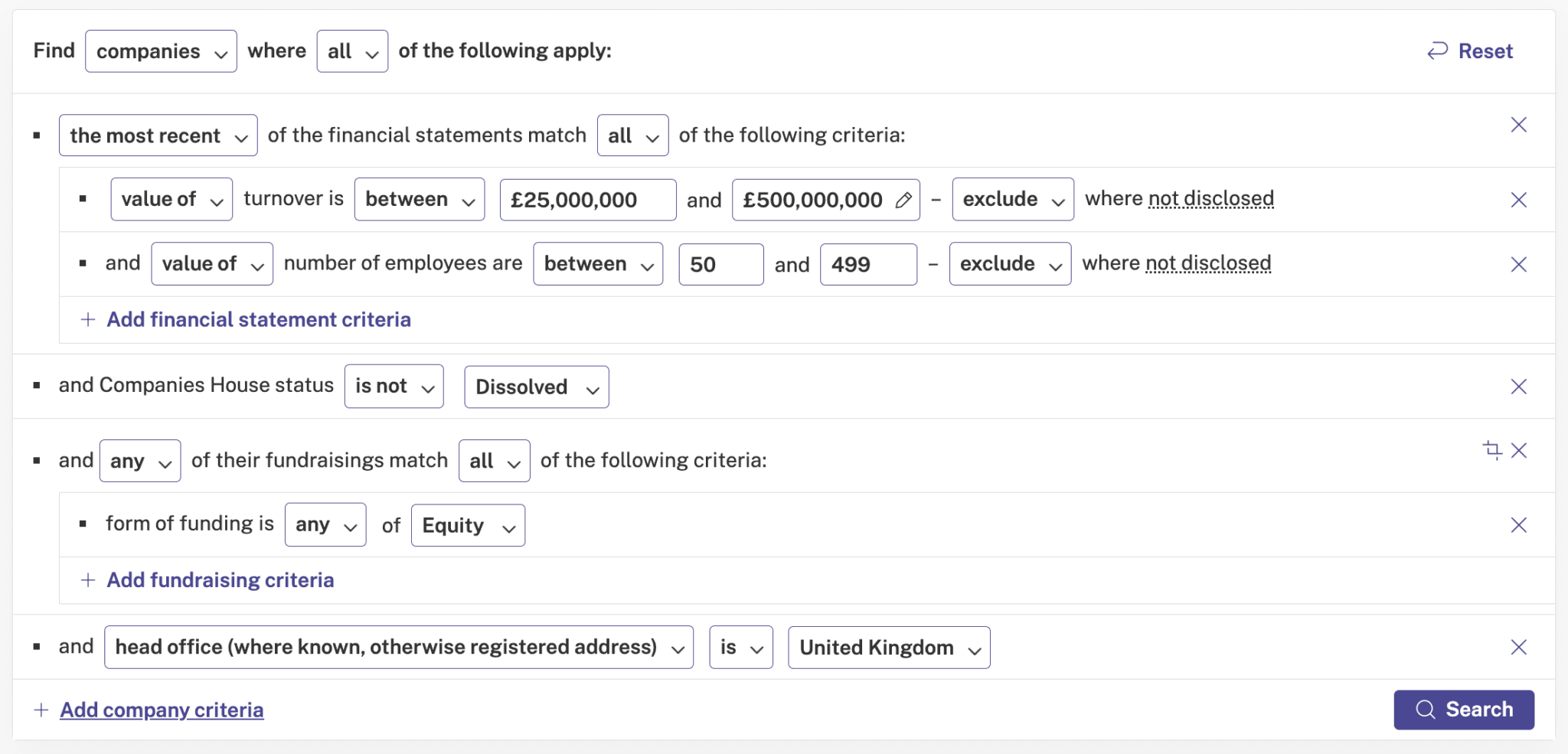
- Turnover of between £25m and £500m
- Headcount of between 50 and 499
- An EBITDA of 10% turnover margin (between £2.5m and £50m)
But in order to see a working definition of MMCs in practice, it’s worth examining the German business industry and its own equivalent ‘Mittelstand’.
Germany’s Mittelstand: A benchmark for success?
When discussing mid-market companies, Germany’s Mittelstand offers a useful comparison. The Mittelstand refers to the country’s highly successful mid-sized businesses, typically family-owned or privately held, that form the backbone of Germany’s economy. One key difference between the UK and Germany is that SMEs form part of the Mittelstand in Germany.
Unlike the UK, where mid-market companies often struggle with visibility and a lack of tailored support, Germany’s policy framework nurtures Mittelstand businesses. This includes favourable financing conditions through loan-based SME financing, targeted government support, and a culture that values sustainable, steady growth over rapid scaling.
Understanding the success of the Mittelstand underscores the importance of tracking company growth and ensuring that businesses receive the right level of support as they scale.