This is the practical companion to How to conduct due diligence on private companies. That piece covers the framework and the workstreams, whilst this article walks you through precisely how teams run that process on the Beauhurst platform.
Where due diligence actually slows teams down
There are three areas that eat up most of the time for advisory teams.
Fragmentation
The information you need sits across Companies House filings, shareholder registers, legal and insolvency records, news coverage, and company websites. For more complex companies, this information can be fragmented across multiple legal entities for the same business.
Manual cross-referencing
Building a complete picture means moving between sources, reconciling them, and doing it again for the next target, often against a deadline.
Missed signals
A recent charge, a fundraising, or a director change can make a material difference. Spotting these late means revisiting work you thought was finished, and creating inconsistencies.
The walkthrough below maps onto the order in which an analyst works, with each stage explaining how the Beauhurst platform can support each step.
Conducting due diligence on Beauhurst
01. Establish the true entity
Start by working out what you’re actually looking at.
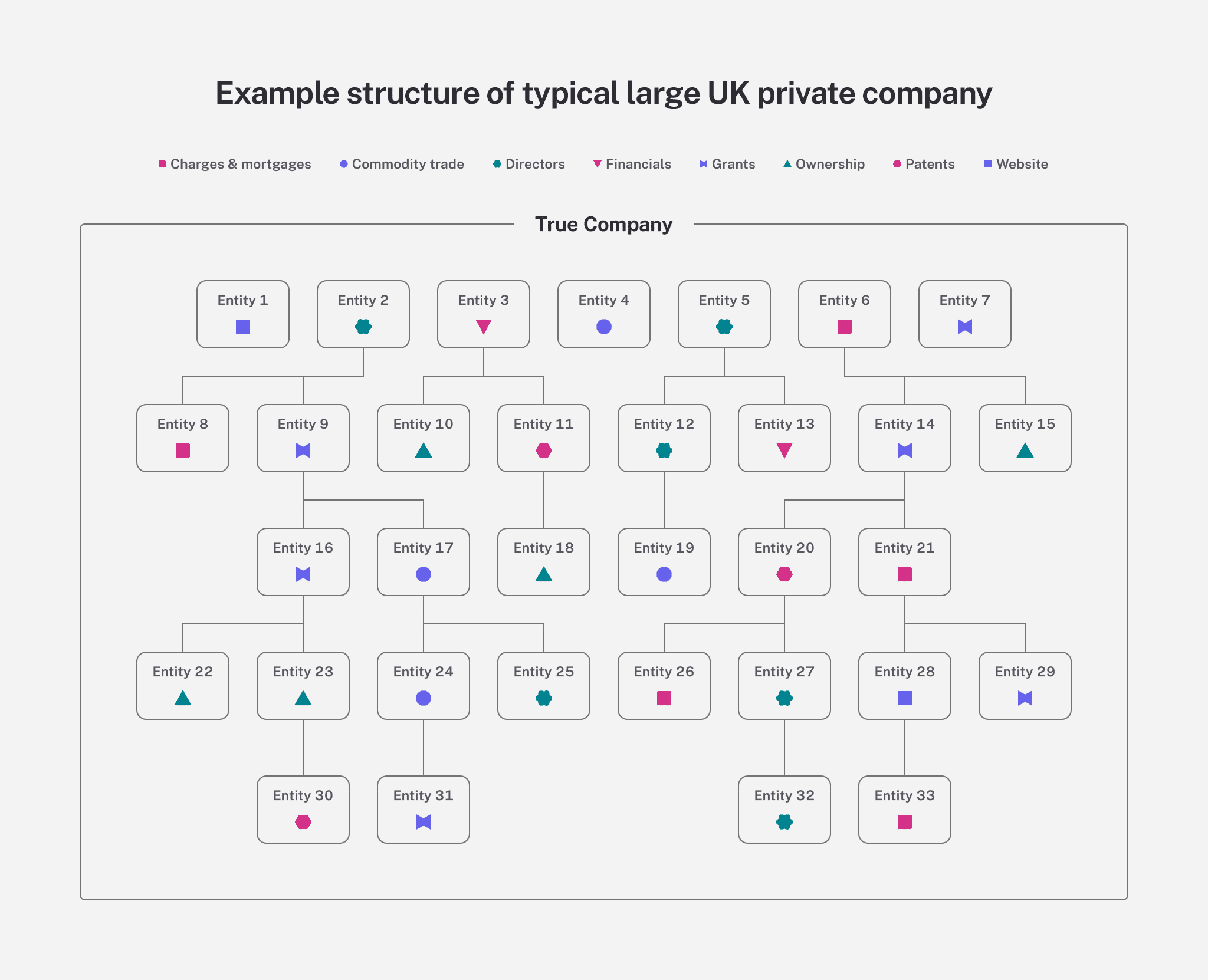
The business you’ve been asked to assess might be one entity among many. For example, there could be a parent above it, dormant shells alongside it, an offshore holding company, or a financing vehicle a layer or two removed.
Pull one set of accounts and you see a slice. The questions that matter in diligence — what the business is worth, what it owes, who controls it — depend on seeing the whole structure at once.
True Companies is Beauhurst’s answer to that. It stitches a group’s separate filings, ownership records, funding history, and public footprint back into one profile, to give you a complete picture of the whole company. That spares the diligence team from reconstructing the org chart from scratch.