Local Growth Index: rethinking Britain’s local economies

Words Callum Newton

Local Growth Index: rethinking Britain’s local economies

There’s rarely been a tougher time to be a council leader in the UK. Real-term budget cuts, growing demand for public services and uncertainty around Local Government Reorganisation (LGR) have created a perfect storm around many council’s ability to deliver meaningful change to their communities. And their voters are noticing.

Earlier this year, polling found that only half of British adults are satisfied with how their council is delivering services (down from 75% during the pandemic) and the number of people who don’t trust their council has overtaken those who do for the first time since 2013.

This is why economic development is crucial to getting many councils out of their financial woes. Introducing policies designed to support local companies growth also helps council coffers grow over the long term, through more business rates revenue and creating more jobs to reduce unemployment. But right now it’s hard for many economic development teams to know where to prioritise resources, what their comparative advantage is and how they stack up against their neighbours.

The geography of growth

This is exactly the problem we’ve been looking to address with Beauhurst’s new Local Growth Index (LGI). Drawing on data from 4.5 million active UK companies, we’ve measured business activity within 361 local authorities against 16 different measures spanning four key pillars of economic activity (innovation, scaling, investment and ESG).

Crucially we wanted to build something a bit different. Instead of measuring raw aggregate values, Beauhurst’s Index looks at the intensity of business activity relative to the number of active companies in each area. This allows us to compare local authorities on a more equal footing, rather than simply rewarding those with the largest business populations or the most investment. So what have we found?
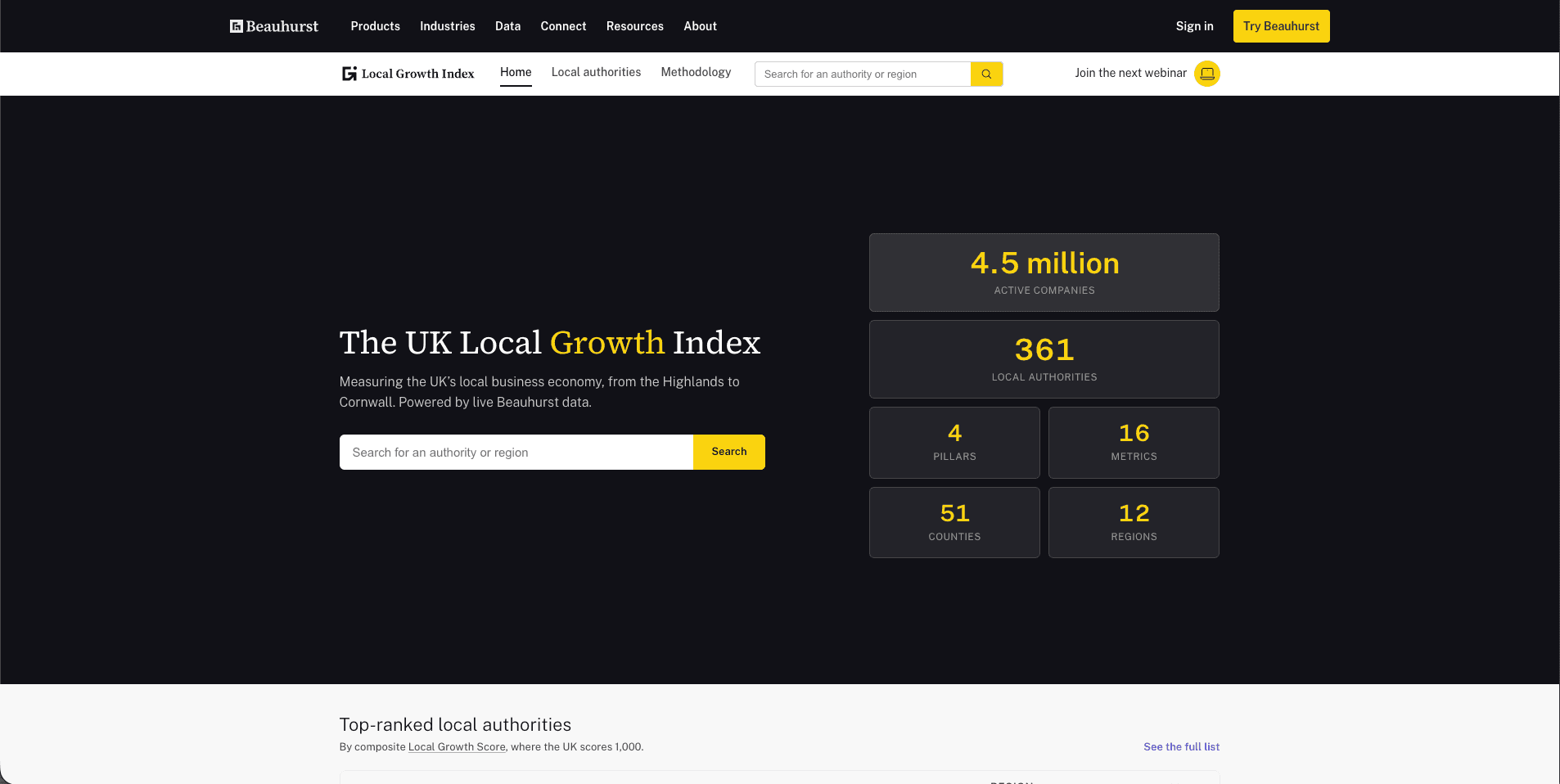
Explore the Local Growth Index →

At first glance, the results are perhaps unsurprising. Cambridge tops the overall rankings with a score of 1,442, followed by the City of London (1,414), Oxford (1,400), South Cambridgeshire (1,398) and Vale of White Horse (1,287). Clearly, the concentration of universities, financial institutions and well-established innovation ecosystems continues to provide these areas with a considerable advantage.

But scratch beneath the surface a bit and things become more interesting. While Cambridge leads the country on innovation, the City of London ranks first for scaling and investment. Meanwhile, the Orkney Islands, with a population of just over 22,000 people, rank eighth overall and first on ESG! Not exactly the first place that springs to mind when thinking about Britain’s most dynamic business economies.

The regional findings also challenge some of our preconceptions about Britain’s economic geography. London still ranks first regionally, but Northern Ireland comes second, ahead of the South West and South East England. The North East also performs marginally better than Scotland and the East of England. While London continues to dominate investment and economic output in absolute terms, its advantage becomes considerably smaller when we account for differences in business population sizes.

Of course, none of this means that Britain’s regional economic inequalities have suddenly disappeared overnight. We’re not measuring GDP, productivity or household incomes. Instead, Beauhurst’s LGI provides a different perspective on the businesses operating within each area, including where they are innovating, attracting investment and scaling successfully.

And this is where things become useful for policymakers. A council with a strong concentration of innovative businesses but relatively few scaleups faces a very different set of challenges from one struggling to attract investment in the first place. Understanding these nuances and differences should be the starting point for deciding where to direct limited resources, rather than pursuing the same economic development strategies as everyone else.

Conclusion

With local government finances under increasing pressure, councils can’t afford to spread their economic development resources too thinly. Nor can every local authority realistically expect to become the next Oxford or Cambridge. The challenge is identifying where their own economic strengths lie and how best to leverage them. Our hope is that the Local Growth Index will provide councils with a useful starting point for doing exactly that, while also opening up some interesting questions about how we measure economic success across the country.

For you the reader we have two extra pieces of good news. First, we’ll be updating the LGI every month using our internal data to help you measure trends over time (watch this space for the next update). Second, we’ll be joining the Local Government Chronicle for a webinar to discuss the LGI in more detail at 11am on Tuesday 24th November. If you’re interested in seeing how your local authority stacks up against the rest of the country, we’d love you to join us!

Register for the LGC webinar

Want to discuss the data? Drop me a message: callum.newton@beauhurst.com

Discover our data

Get access to unrivalled data on all the companies you need to know about, so you can approach the right leads, at the right time.

Book a demo today to see all of the key features of the Beauhurst platform, as well as the depth and breadth of data available.

An associate will work with you to build a sophisticated search, returning a dynamic list of organisations that match your ideal customer profile.