Beauhurst supplied data for the Government’s consultation Financing Growth in Innovative Firms, and has now submitted its response to the government’s Patient Capital Review – a summary of which is below.
The problem: are companies struggling to scale?
605 companies raised seed rounds in 2011, 39 of which are now growth-stage. Based on the funding those companies used to scale, we estimate that an extra £8.9bn of investment (over six years) would have been required to enable the remaining businesses to reach growth-stage. Given that more than 7,000 companies have raised seed rounds since then, the overall requirement is more like £100bn.
This assumes, of course, that all firms which raise a seed round are capable of reaching growth-stage, and that those that did not were only lacking capital. It also assumes that all companies require a similar amount of capital to scale, which of course is not necessarily true (a pharmaceutical firm might require much more intensive funding than, say, a food delivery startup).
Nonetheless, the figures are stark, and 19% of the 2011 companies remain at the seed-stage six years on. That’s a strong indicator that patient capital is required.
What does patient capital look like right now?
The Treasury’s initial consultation, Financing Growth in Innovative Firms, identified crowdfunding as a positive contribution to the patient capital landscape. We’re not convinced, however, that there’s enough data to draw such a firm conclusion yet.
Instead, it’s likely that crowdfunding will be a mixture of patient and non-patient, given the diversity of investments it facilitates. In short, sometimes crowdfunding campaigns will be helpfully patient, and sometimes they will be damagingly impatient.
We’re also concerned that activity by the British Business Bank and the European Investment Fund might not be the answer to the patient capital shortfall. Both invest into UK-based venture capital firms – most of which operate with investment horizons of 8-10 years. That timeline isn’t what’s traditionally considered patient: we actually found that the average age of acquisition for a high-growth UK company is 13.5 years, and the average IPO happens when a company is 10 years old.
Why isn't there more of it?
Because investors aren’t convinced that it yields better returns. Traditional PE and VC firms already make good returns; truly patient capital’s record is unproven. So investors are waiting on strong evidence that patient capital works, or – failing that – some kind of guarantee that they wouldn’t lose money by investing in such a risky way.
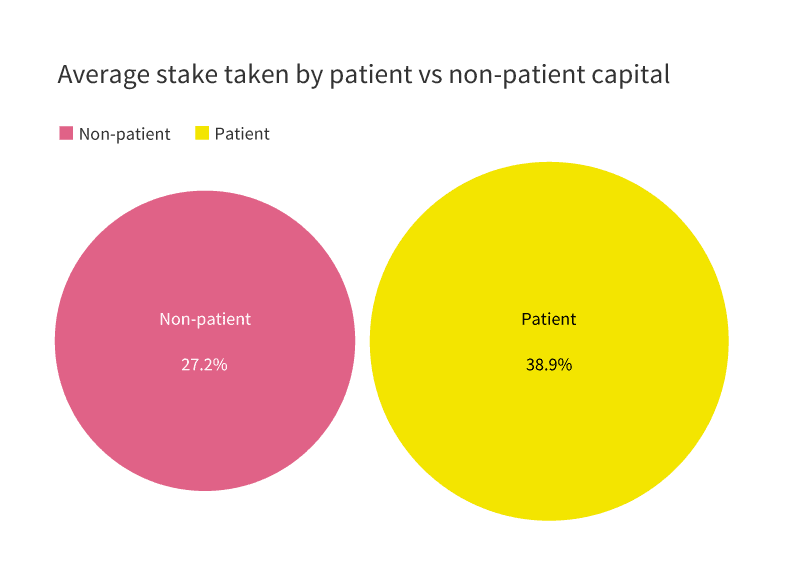
Entrepreneurs might not be that enthusiastic to take patient capital, either: patient investors typically take a larger stake, as we showed previously. If those offering long-term investment demand more in return, it’s possible that they themselves are putting young companies off patient capital.