Total Liability

Words Callum Newton

Total Liability


How balance sheets make and break the Premier League?

The World Cup is over. As expected, England got knocked out in the semi-finals, Spain sailed to victory and Infantino has managed (somehow) to keep his job. But as the “greatest show on Earth” comes to a close, the return of club football is now only days away. Fans up and down the country are no longer talking about the closing ceremony, but are instead returning to an age-old question which has blighted the Premier League for decades: club finances.

It is notoriously difficult to effectively measure football club finances in the modern age. But in this month’s Substack the Beauhurst Insights team wanted to measure how much of an impact balance sheets have on a club’s success, ranging from relegation battles to silverware.

Using Beauhurst data, we analysed the financial statements of clubs that have played in the Premier League since 2015/16, linking approximately 200 club-seasons to league results, relegation, European qualification and major domestic and European trophies. The results suggest that money does matter. But the relationship between spending and success is more complicated than us fans might think.

Player assets, turnover and league position

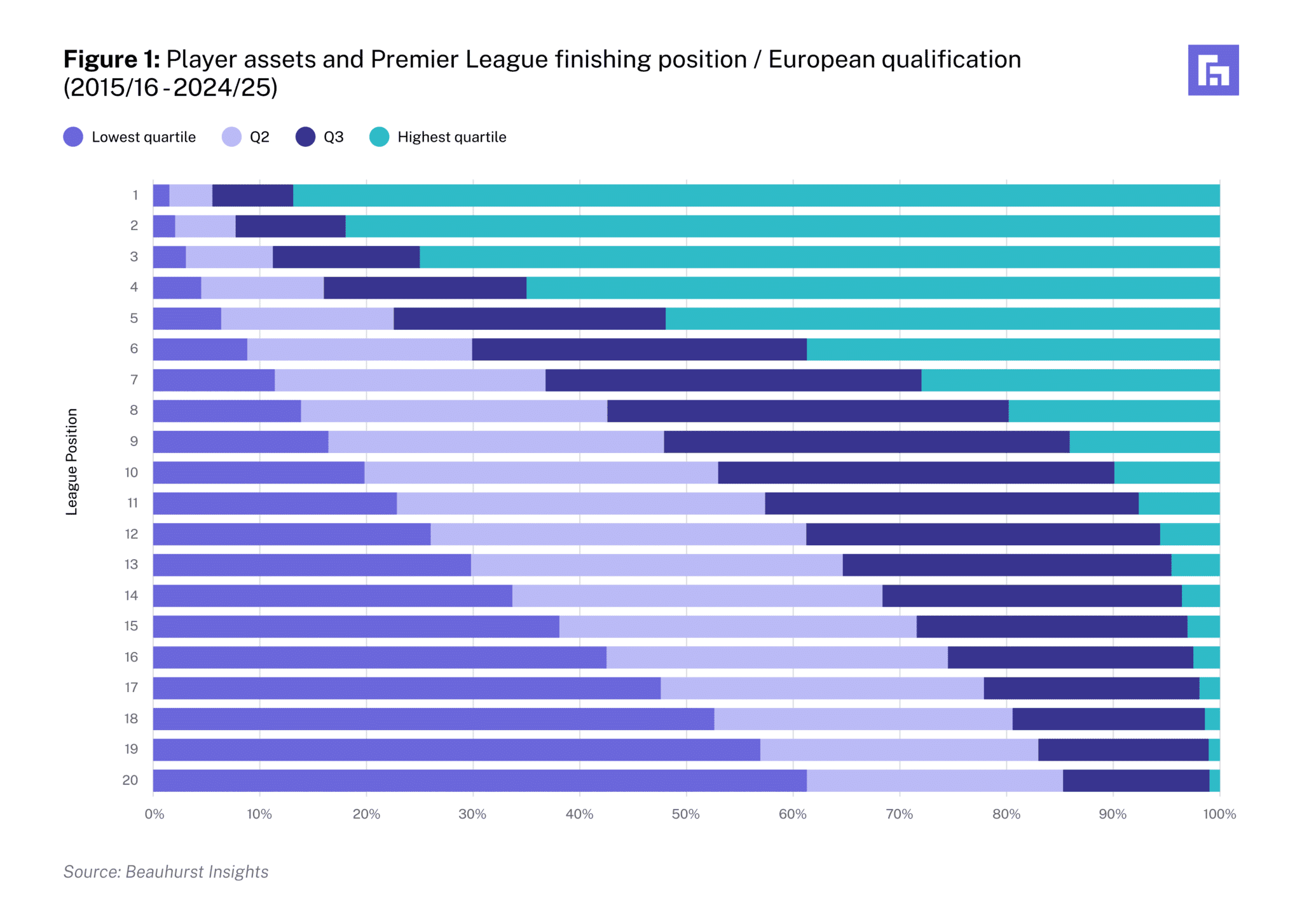
The first finding is straightforward: clubs with larger player asset bases tend to finish considerably higher up the Premier League. Since the 2015/16 season, clubs in the highest quartile for intangible assets (often associated with the value of players bought by a club) finished in an average position of around 4.5th, compared with approximately 14.6th for clubs in the lowest quartile.

The gap becomes even more pronounced when looking at qualification for Europe. Around 80% of club-seasons in the highest player-asset quartile resulted in a top-six finish, compared with just 6% among clubs in the lowest quartile.

This does not necessarily mean that simply buying more players causes a club to rise up the table. The Premier League’s largest clubs also generate considerably more revenue, allowing them to sustain bigger squads, higher wages and larger transfer commitments year after year. Indeed, turnover remains one of the strongest predictors of league performance in our analysis. Clubs in the highest turnover quartile averaged around 74 points and a fourth-place finish, with approximately 85% finishing in the top six.

The financial divide is therefore about scale as much as spending. Clubs consistently competing for European football operate with fundamentally larger economic and playing asset bases than most of the division.
bar chart 1

The financial cost of Premier League survival

If established clubs occupy different financial tiers, the transition from the Championship into the Premier League is particularly revealing. The Beauhurst Insights team identified 25 promoted club-seasons where sufficient financial data was available to compare a club’s first Premier League season with its position before promotion.

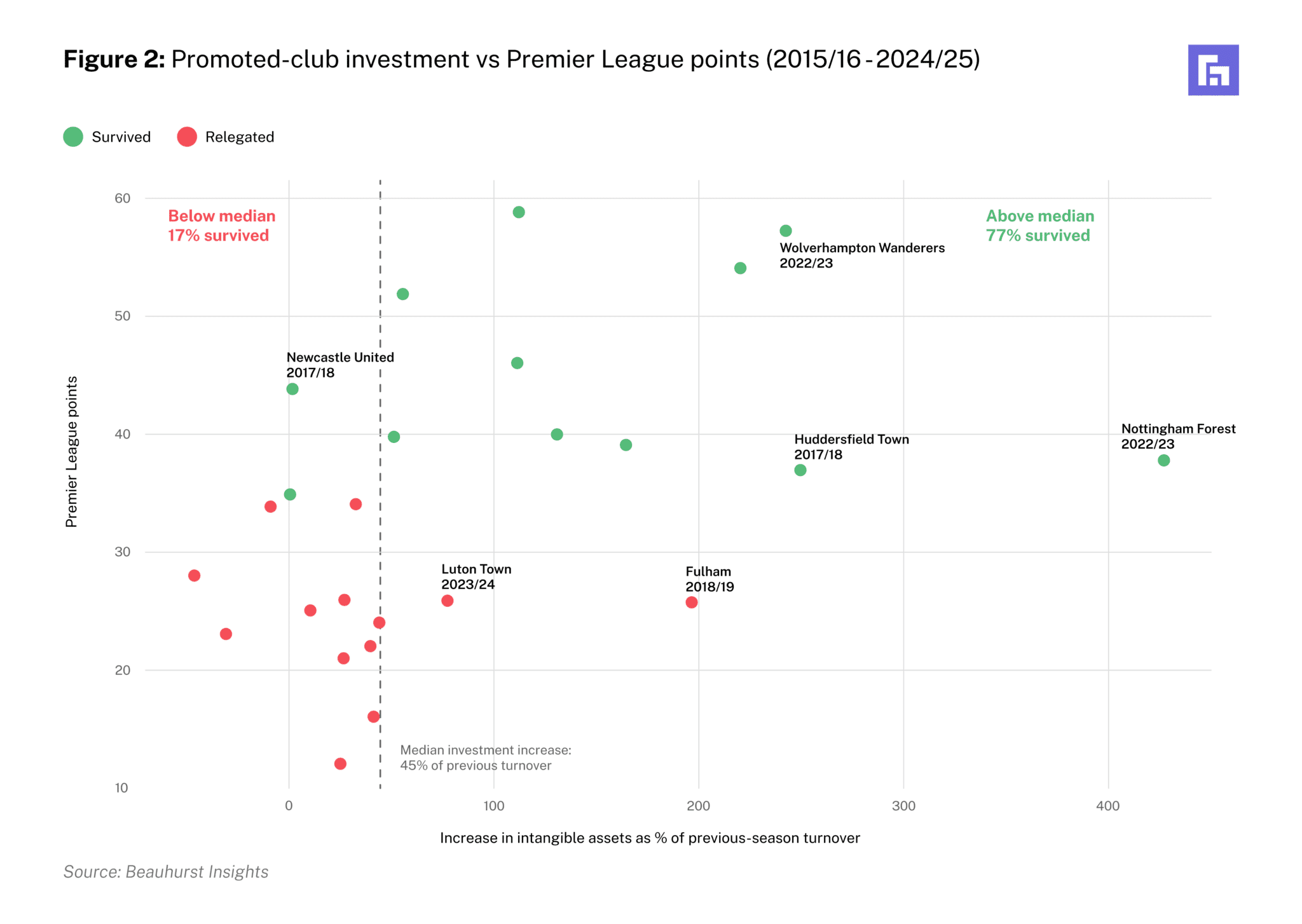
The difference in balance sheets between those that survived and those immediately relegated was especially striking. Promoted clubs that stayed in the Premier League during their first season increased their intangible assets by a median of around £39.4m. For clubs that went straight back down, the median increase was only £14.2m. Looking at investment relative to the existing size of the club produces an even clearer divide. Among promoted clubs making an above-median increase in intangible assets relative to their pre-promotion turnover, around 77% survived. Among those below the median, only 17% did so.

The relationship can also be seen in league points. Promoted clubs making larger increases to their playing asset base generally accumulated more points during their first Premier League campaign. Importantly, the same pattern was not evident in wages. Surviving promoted clubs increased their wage bills by a median value of roughly £32.9m, compared with around £30.2m among relegated teams.

That suggests paying more is not enough. The composition and quality of the squad being assembled may matter more than the overall increase in payroll. Nor is investment a guarantee. Several promoted clubs have spent heavily and still been relegated, while others have survived with comparatively limited balance-sheet expansion. Recruitment quality, coaching and the strength of the existing squad remain critical. But the overall pattern suggests promotion comes with a genuine financial cost of entry. Teams arriving from the Championship may need to make a substantial step-up in their playing assets simply to compete with established Premier League opposition.

How money shapes Premier League silverware

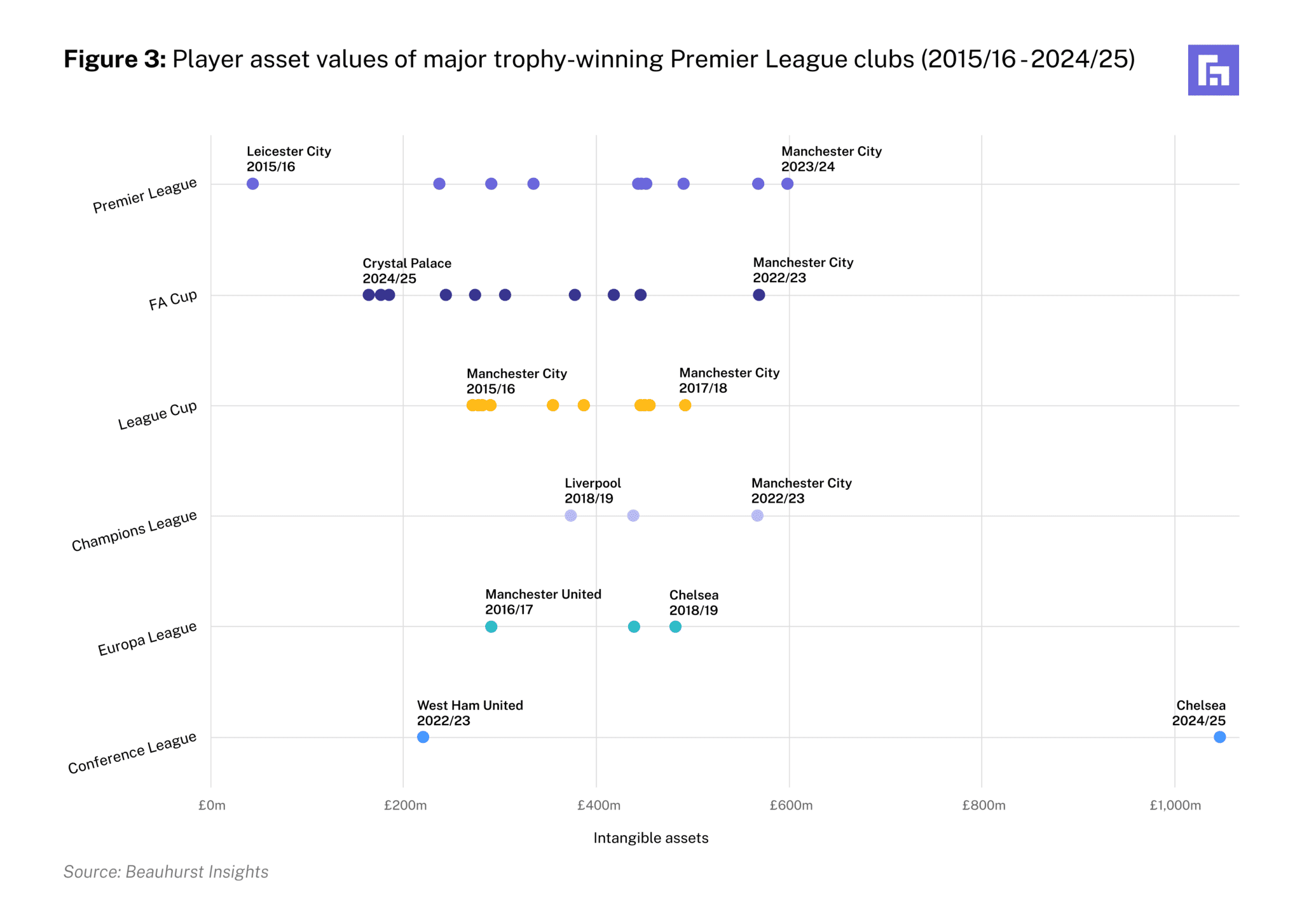
The financial hierarchy becomes even more pronounced when we look beyond league position and towards silverware. Between 2015/16 and 2024/25, Premier League clubs won 38 major domestic and European trophies across the Premier League, FA Cup, League Cup, Champions League, Europa League and Conference League. Of those trophies, 29 (76%) were won by clubs sitting in the highest quartile for player-related intangible assets in that season. Extending the measure to the top half of clubs by player assets captures 36 of the 38 trophies – equivalent to 95% of total silverware.

At the other end of the spectrum, clubs in the lowest player-asset quartile won no major trophies at all during the period analysed. The exceptions underline just how unusual genuine financial overperformance can be. Leicester City’s 2015/16 Premier League title and Crystal Palace’s 2024/25 FA Cup victory were the only two trophies won by clubs outside the top half of the league for player assets.

European success was even more concentrated. Seven of the eight European trophies won by Premier League clubs during the period went to teams in the highest player-asset quartile. Yet there is another important twist. Among established Premier League clubs, making the largest year-on-year increase in player assets did not make a team more likely to win silverware. This suggests that trophy success is associated less with one particularly expensive transfer window than with having already accumulated the financial scale required to compete at the highest level. The biggest clubs buy themselves repeated opportunities to win. They do not buy certainty.

scatterplot chart 2

Can money buy Premier League success? The verdict

So, can money buy Premier League success? The evidence suggests the answer is both yes and no. Money appears particularly important at two stages of the Premier League hierarchy. For newly promoted teams, substantially increasing the playing asset base is strongly associated with survival. At the other end of the table, clubs with the largest accumulated player assets overwhelmingly dominate European qualification and major silverware.

To put this in context, winners of the Premier League had an average player-asset base of £389m, a level that 89% of club-seasons in our dataset fell below. Across all major trophy winners, the equivalent figure was £368m, above 87% of club-seasons.

This is not an especially groundbreaking finding. Ask anyone watching a match in the pub and they’ll tell you the “Top Six” are there because they can spend big when others can’t (especially following the introduction of PSR and FFP). But spending more in a single season does not guarantee that an established Premier League club will climb the table or win a trophy.

The same applies to liabilities. The Premier League’s most successful clubs often carry enormous liabilities in absolute terms, but this relationship largely disappears when liabilities are measured relative to turnover. Their larger commitments are supported by much larger revenues. The Premier League therefore appears to have both a financial entry fee and an elite financial tier. Money cannot guarantee footballing success, and nor should it. But over the past decade, achieving sustained success without it has been exceptionally difficult.


Subscribe to the Beauhurst Insights Substack

Data-led analysis of the UK’s private companies, straight to your inbox.

Subscribe
Discover our data

Get access to unrivalled data on all the companies you need to know about, so you can approach the right leads, at the right time.

Book a demo today to see all of the key features of the Beauhurst platform, as well as the depth and breadth of data available.

An associate will work with you to build a sophisticated search, returning a dynamic list of organisations that match your ideal customer profile.