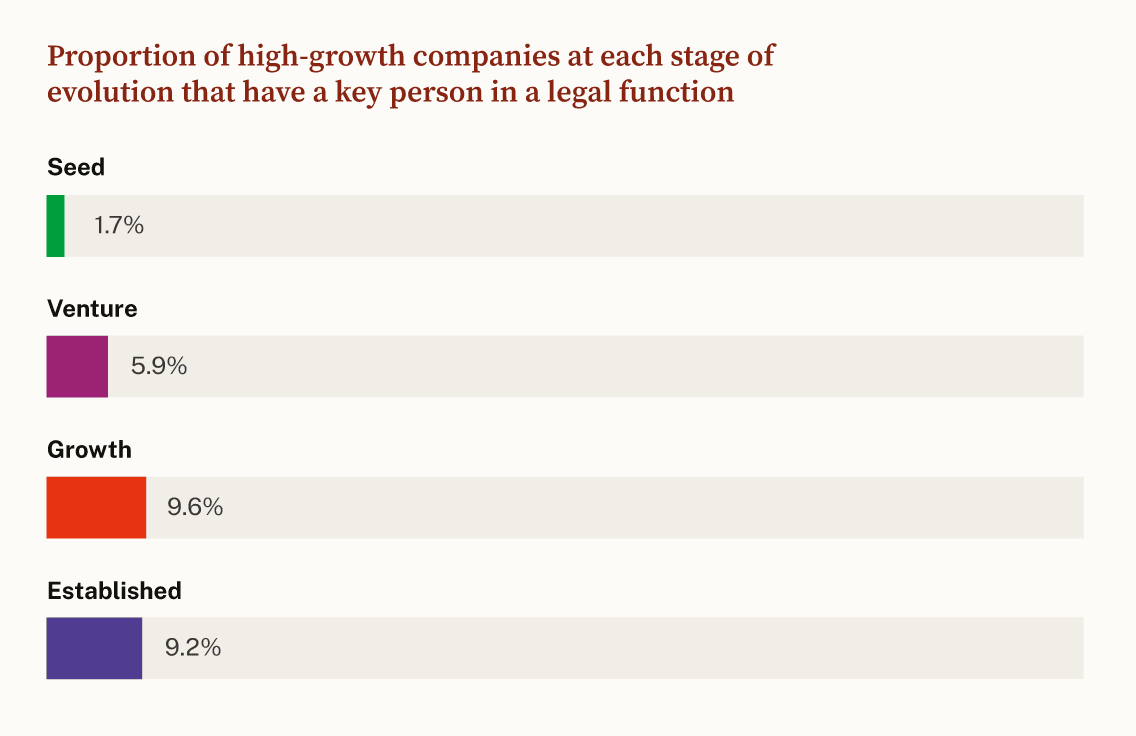
Helen Goldberg, COO of LegalEdge, tells us that:
“It’s common in the UK and the rest of Europe for legal to be a late hire. It’s often not necessary until a COO or CFO finds they’re spending too much time dealing with contracts and compliance, managing external lawyers, and dealing with expensive retainers and hourly rates. Or they’re holding new business deals up because they can’t do both jobs properly. Or, worse, a ball is dropped and something goes wrong. These things are usually the catalyst for assessing the in-house legal function (or lack of one) and looking for an alternative and better way of managing the work and budget.”
Through her work at LegalEdge, Helen has found that there are often key business milestones that trigger the need for an in-house legal hire. These can include transactional events like a significant fundraising round, merger, or an upcoming exit, or a concern that their current systems cannot scale at the same pace as the company.
Guy Hutchinson, Co-Founder of Startup CFO—the leading community of Finance leaders operating in the startup and scaleup space—explains:
“We shouldn’t be surprised that high-growth businesses are starting to look towards in-house legal counsel hires at the growth stage of evolution. It’s partly the economics of the hire and the business requiring real scale to have sufficient activity to justify the full-time head. It’s also partly a testament to the capacity for CEOs and CFOs to work well with their external lawyers when critical things need to be attended to in the venture and earlier phases.”
These differences aren’t consistent across geographies: although our data only covers UK companies, anecdotal evidence shows that startups and scaleups in the United States are more open to hiring business lawyers earlier on in their growth journeys. Helen suggests that this is down to how the legal function is treated:
“In the UK, legal is more often viewed as an unnecessary expense and it’s often a distress purchase, so lawyers are called in to deal with specific legal issues, rather than being proactive to prevent them from happening in the first place.” She adds that “it’s wrong to think of a startup lawyer as an expensive hire that’ll slow down deals and cause headaches. If you employ someone like that you’ve hired the wrong person.”
“In the US, however, it’s more common for legal to be an early hire, and treated as an investment, with value placed on being proactive with legal and compliance matters. And it’s not just because the US is so litigious, in-house lawyers there are valued for their sound judgement, integrity and oversight of the business as a whole.”
Meanwhile, Guy notes that the level of growth necessary before hiring a senior legal function “may come earlier in US tech companies, and that is mainly associated with the size of the domestic market and how quickly a US business can grow its operations.”
As well as trends across company stages, there’s also a clear correlation between legal and finance roles. Our data shows that 14.1% of companies with a senior finance function also have a senior legal function, whilst just 2.4% of companies without a senior finance function have a senior legal function. According to Helen, this “absolutely makes sense, as we are increasingly finding that it’s the CFO or FD who brings us in to take legal off their plate, set up the legal function to manage the legal work and budget, and to help manage risk.”
When should a startup bring in a senior legal function?
Noting that budgets are tight whilst a company is in startup mode, Helen tells us that ad-hoc support and contract templates usually suffice in the early stages. Still, making sure the company is well set up is incredibly important, especially when it comes to equity ownership and IP. More regular support—around two to seven days a month—becomes necessary with greater revenue and employee numbers, especially if the company is fundraising and needs to dedicate time to due diligence.
Businesses face increasing scrutiny as they become more established, so need to have more robust contracts, policies and processes in place for employees and third parties. Helen warns that “many SMEs will go back to the law firm they used for their fundraising when, in fact, they need a good commercial or in-house lawyer, who understands how the company operates, can do a cost/benefit analysis, and who will be more cost-effective.” She adds that “it’s important to hire someone who has worked in a similar sector and type of business, so they know what is important and how to prioritise”.
Guy also points out that hiring an in-house lawyer may need to come much earlier on for businesses with substantial legal complexities, such as fintech companies. He tells us that “they really should have an internal legal counsel on the hiring list once the Series B is complete. Whilst law firms are the go-to for major transactions, such as supporting funding processes, new models where legal counsel are available on an outsource model can provide a good approach, particularly where ongoing commercial work is a requirement.”
What value does the legal function bring to startups and scaleups?
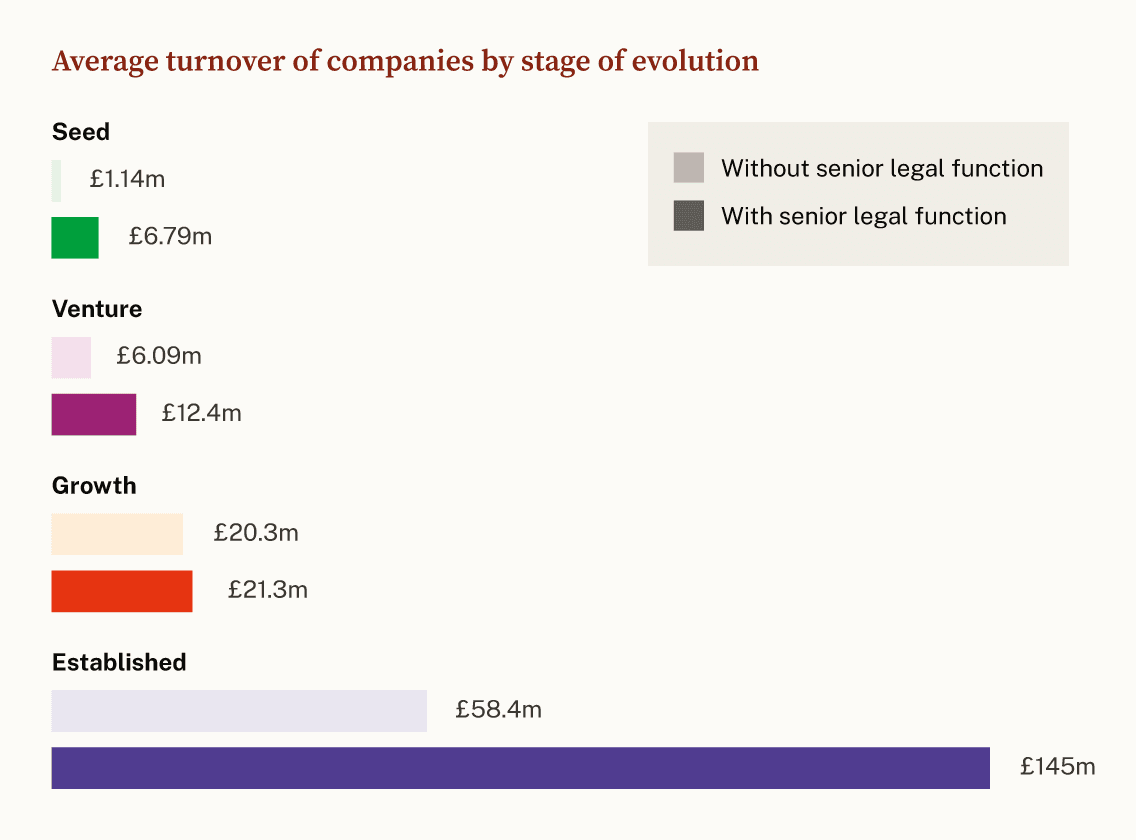
According to Helen, “the right legal resource can directly and positively impact the sales cycle and drive, or at least facilitate revenue growth (as well as keep costs under control)—speeding up deal closure and getting revenue in the door more quickly.” Indeed, our research shows that companies with a senior legal function have a higher average turnover than those that don’t—of course, this data could simply be indicative of the fact that companies with higher turnover have a greater need and greater budget for in-house lawyers.