The German private sector is renowned for its Mittelstand, technical innovation, and global export strength — particularly in the automotive sector, where Germany ranks as one of the largest exporters of cars.
But if you were to ask five investors about the current state of private company investment, you’d likely get five different answers — each shaped by their respective networks, experiences, and geographic location.
This partly reflects the decentralised nature of company registration in Germany, where information is spread across multiple regional instances of the Handelsregister. Plus, reporting requirements tend to vary by company type and federal state.
In short, getting a clear picture of the state of investment in Germany — certainly on a company level and outside of the high-profile fundraisings — can be a real challenge.
This is where private company data platforms come into play.
What is private company data?
Before we examine the trends you can draw from access to company data, it’s worth explaining specifically what we mean by the term ‘private company data’.
In this instance, we’re talking about key business facts and figures, including (though not limited to):
- Basic info: Name, registered address, legal status, founding date, corporate structure
- People: Founders, directors, board members
- Sectors: Industry tags, innovation labels (e.g. AI, cleantech)
- Funding: Equity deals, investors, cap tables, funding amounts, dates
- Financials: Revenue, headcount, profit, GVA (gross value added)
- Grants & support: Public funding, accelerators
- IP & R&D: Patents, innovation activity
- Press: News coverage, announcements
- Growth signals: Hiring, expansion, partnerships
Some of these are publicly available on the Handelsregister, whilst others are not, or are harder to find — especially if the company hasn’t issued a press release.
What private company data can tell you
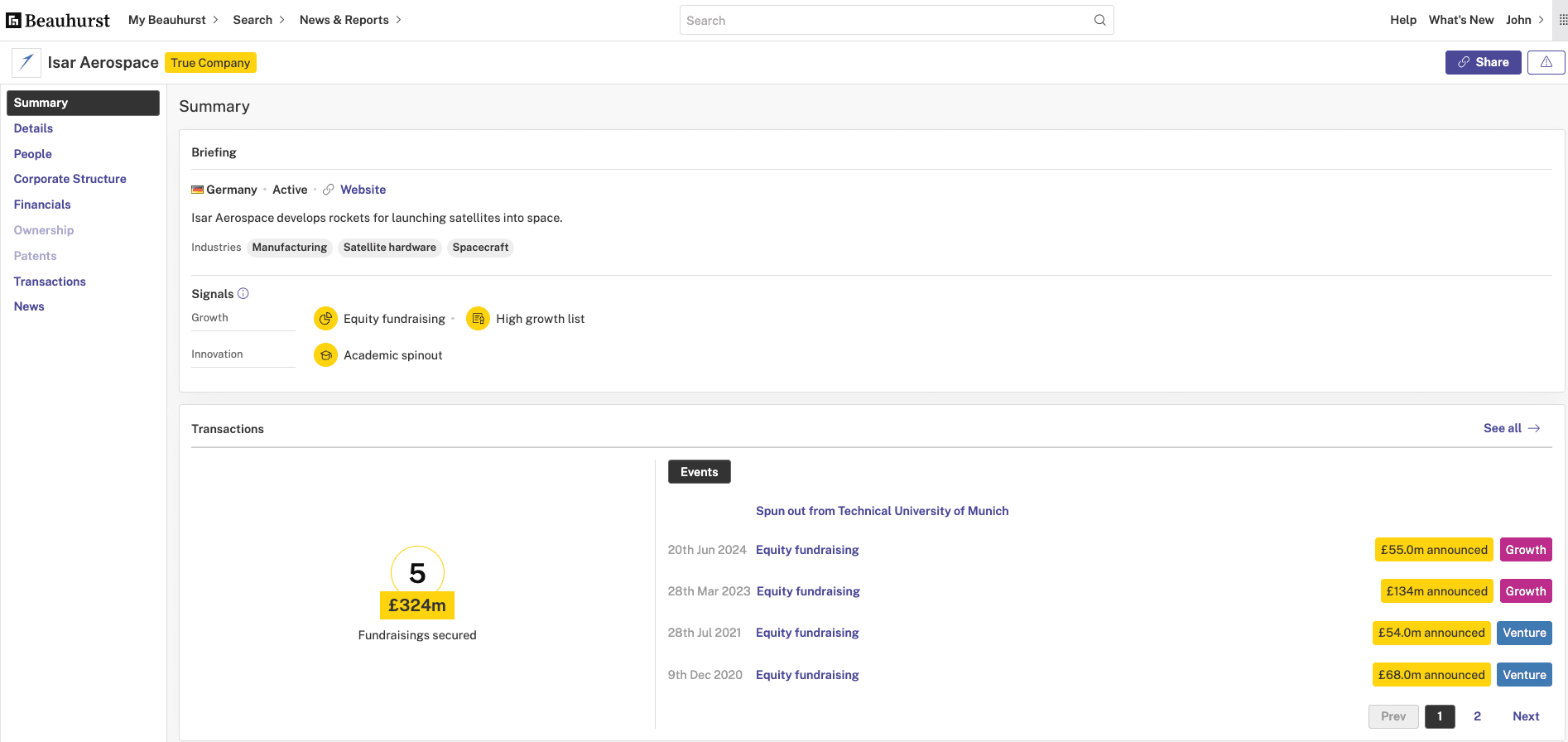
With access to high-quality, proprietary company data via a platform (like Beauhurst), you can begin to establish broader market trends by analysing segments of the market on a macro basis.
For example, if you’re in corporate finance, you could use this information to find companies with ageing directors and strong cash reserves, which could be about to undergo succession planning.
Similarly, if you’re an investor, you could look for innovative early-stage companies with unique intellectual property (IP) that are seeking to scale their operations and become profitable.
Here are some examples:
- 214 companies in Germany received equity funding in the first half of 2025 — with three raising over £100m each
- 75% of these companies (162) were based in either Berlin (91), Munich (46), or Cologne (25)
- Investment in the German startup market grew by €1b between 2023-2024
- The turnover of the top five automotive companies in Germany totalled €681b in 2023
Of course, in some cases, company financials are not so easily accessible. In April 2025, the UK government changed the audit threshold for companies, allowing them to file full accounts only if they have a £15m+ turnover. And in Germany, there is no audit requirement.
Fortunately, there are other ways that private company data can reveal interesting things about the German investment market.