Find, track, and understand the companies making a positive impact on the environment and society
ESG (Environmental, Social, and Governance) has been a hot topic in business circles for quite some time now. Now, more than ever, companies are looking to build specific ESG policies to reduce their carbon footprint, attract diverse talent, and demonstrate responsible corporate ownership.
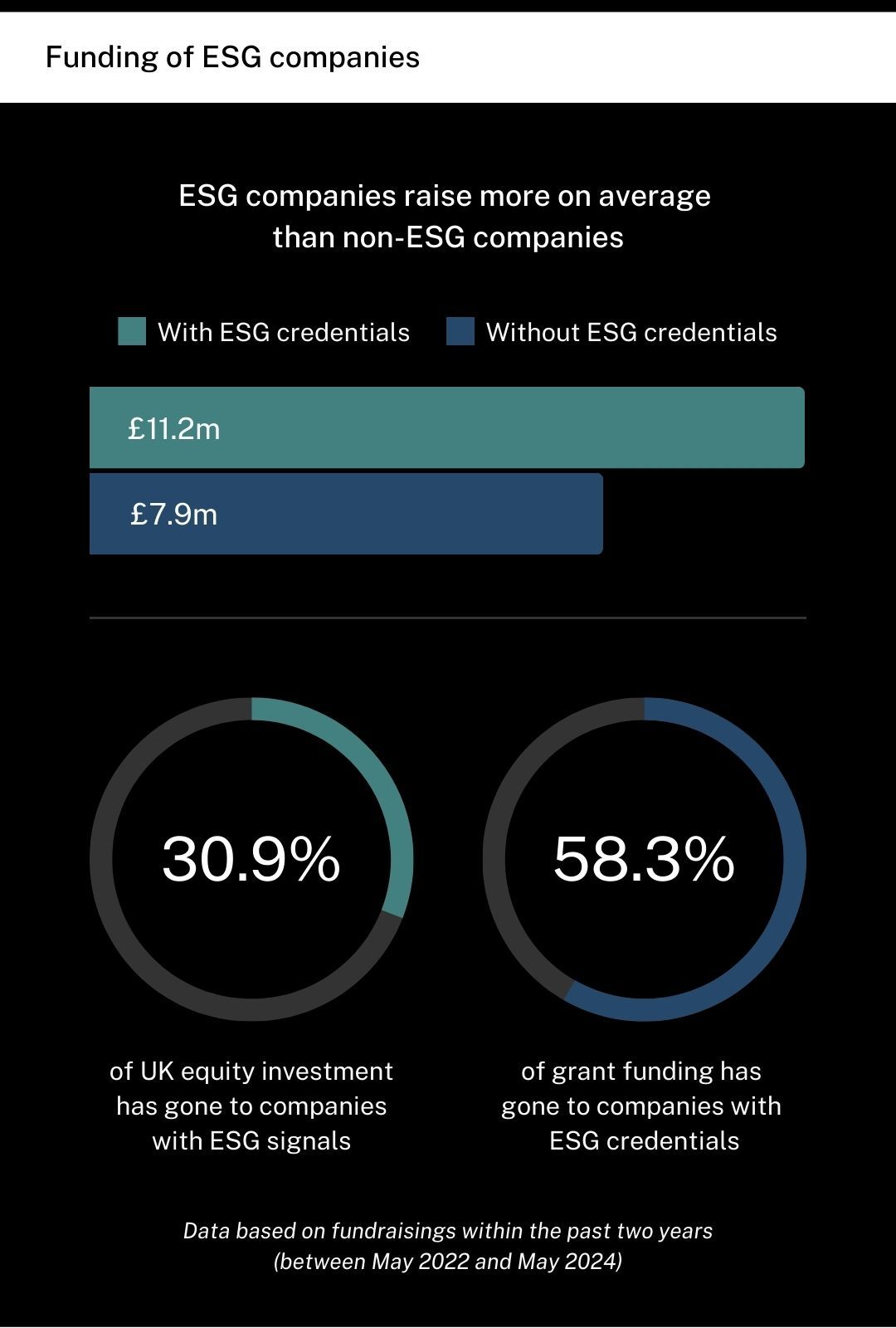
Despite some public climb-downs (take Unilever’s unexpected backtrack on ESG commitments as an example), ESG reporting remains important. And the investment market agrees — our own data shows that 30.9% of equity funding from May 2022 to May 2024 has gone to companies with ESG credentials.
Meanwhile, Thomson Reuters’ The 2023 State of Corporate ESG found that “Despite rising costs of capital from rapid interest hikes and much-publicized political and shareholder pressures […] ESG remains a major focus.”
But for many, the unavoidable questions are, what does ESG mean for businesses, and how can it be quantified? Well, that’s where we come in. We’ve developed an ESG dataset that makes ESG quantifiable.
ESG explained
As Chynna Brenham, our Data Strategy Manager, explains, “ESG is a set of standards for identifying the impact of a company on society, the planet and the world at large.”
Here’s how we define ESG at Beauhurst.
Environmental
The E in ESG, unsurprisingly, concerns the environment. This describes companies that are creating innovative solutions to build a greener, more sustainable world and tackle climate change, or are taking significant steps to reduce their organisation’s impact on the environment.
Social
The social aspect of ESG refers to how a company manages relationships with its employees, suppliers, customers, and the communities it operates in. It encompasses a wide range of issues related to DEI initiatives, working practices, and customer satisfaction.
Governance
Governance refers to the system of processes, decision-making, and logistics involved in running a business. This includes ensuring accountability, fairness, and transparency in an organisation and reporting on these factors to shareholders.
At Beauhurst, we defined and launched our own ESG dataset to enable our clients to understand whether a company is having a positive environmental or social impact. That’s because we believe that there doesn’t have to be a trade-off between economic growth and a positive impact on the world.
What are Beauhurst Signals?
We know that just having data isn’t the answer — you also need to be able to interpret it. That’s why we created Signals as a way to make our data easier to understand. We have five groups of Signals that indicate whether a company has a particular characteristic.
They are:
- Growth
- Innovation
- Environmental
- Social & Governance
- Risk
Beauhurst Signals mean that our clients don’t need to be data analysts to do sophisticated work, they just need to hit a few buttons.
Our ESG Signals
Here’s a very brief breakdown of what goes into each Signal. For a full rundown on our methodology, check out our interview with the creator of the dataset, Chynna Brenham.
Environmental Signals
Green transport
Companies with activities related to developing electric vehicles and their parts, infrastructure, and storage, as well as consulting in this space.
Clean and renewable energy
Companies involved in developing alternative or renewable energy sources, such as wind and tidal. They may also manufacture parts, develop storage solutions, or work in clean energy consulting.
Green building and infrastructure
Companies with pollution and waste management activities, such as air or noise pollution, and recycling. They may also develop building technologies and infrastructure such as heat retention, flood management and insulation or focus on environmental consulting.
Sustainable farming and food production
Companies with sustainable agriculture and food production activities. This includes alternative farming methods, the development of natural pesticides and insecticides, and low-carbon meat or dairy alternatives.
Environmental accolades
Companies with this Signal have been backed by a fund, attended an accelerator, or featured on a high-growth list that has a positive environmental focus.
Social & Governance Signals
Gender pay equality
Companies achieve this Signal if the difference between men and women’s average hourly pay is no greater than 5%.
Gender equality of directors
Companies hit this Signal if the percentage of women directors is between 45% and 55%, excluding companies with less than two directors and where the gender is unknown.
Age diversity of directors
Companies hit this Signal if the coefficient of variation of the age of the board of directors is over 0.25, excluding companies with 1-2 active directors and those with directors under age 18 and over 100. Diversity means more generations on the board.
Social accolades
Companies with this Signal have either been backed by a fund, attended an accelerator, or featured on a high-growth list that has a social impact focus.
How to find and use our ESG data
By combining ESG data with our best-in-class UK company data, you are now able to identify, monitor, and capitalise on opportunities across the economy. Fortunately, finding companies with ESG Signals on Beauhurst is incredibly simple.
Check out this short guide to learn how: