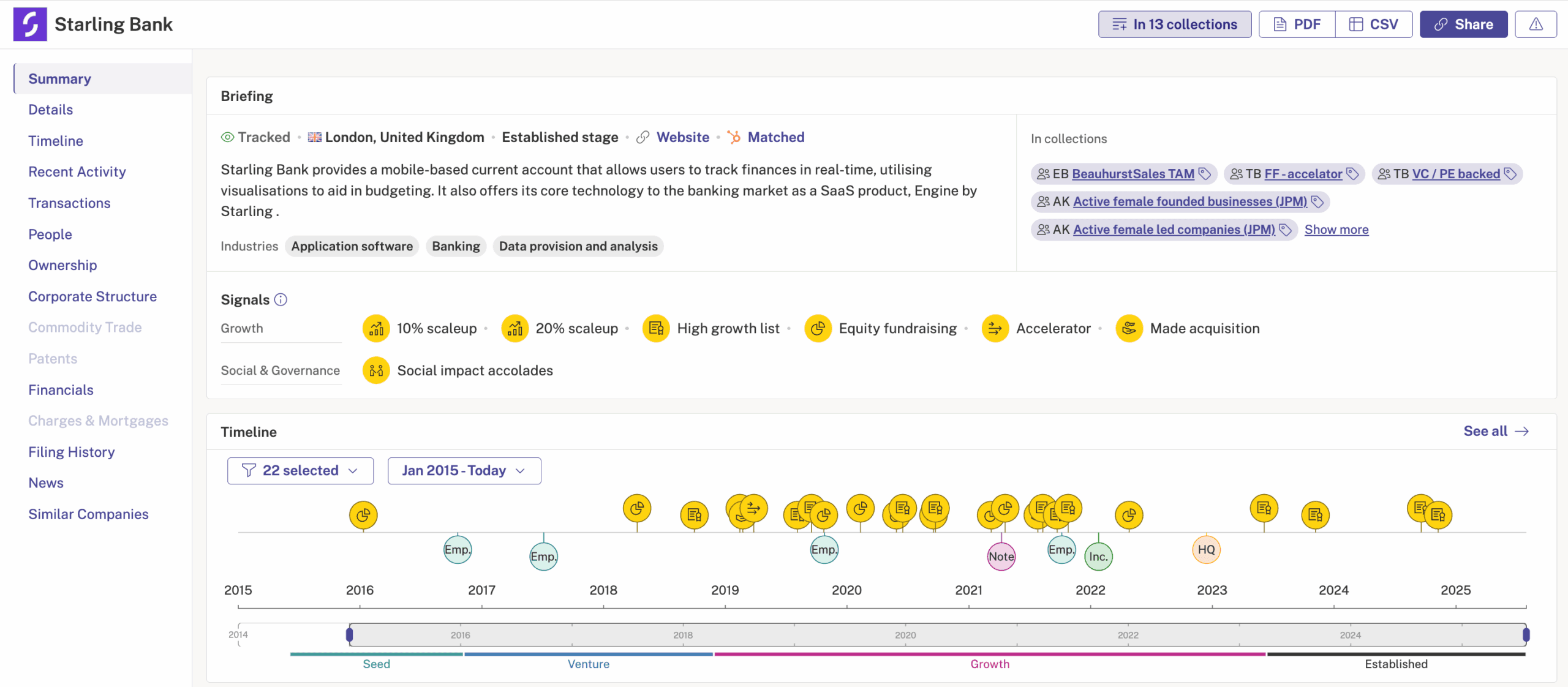
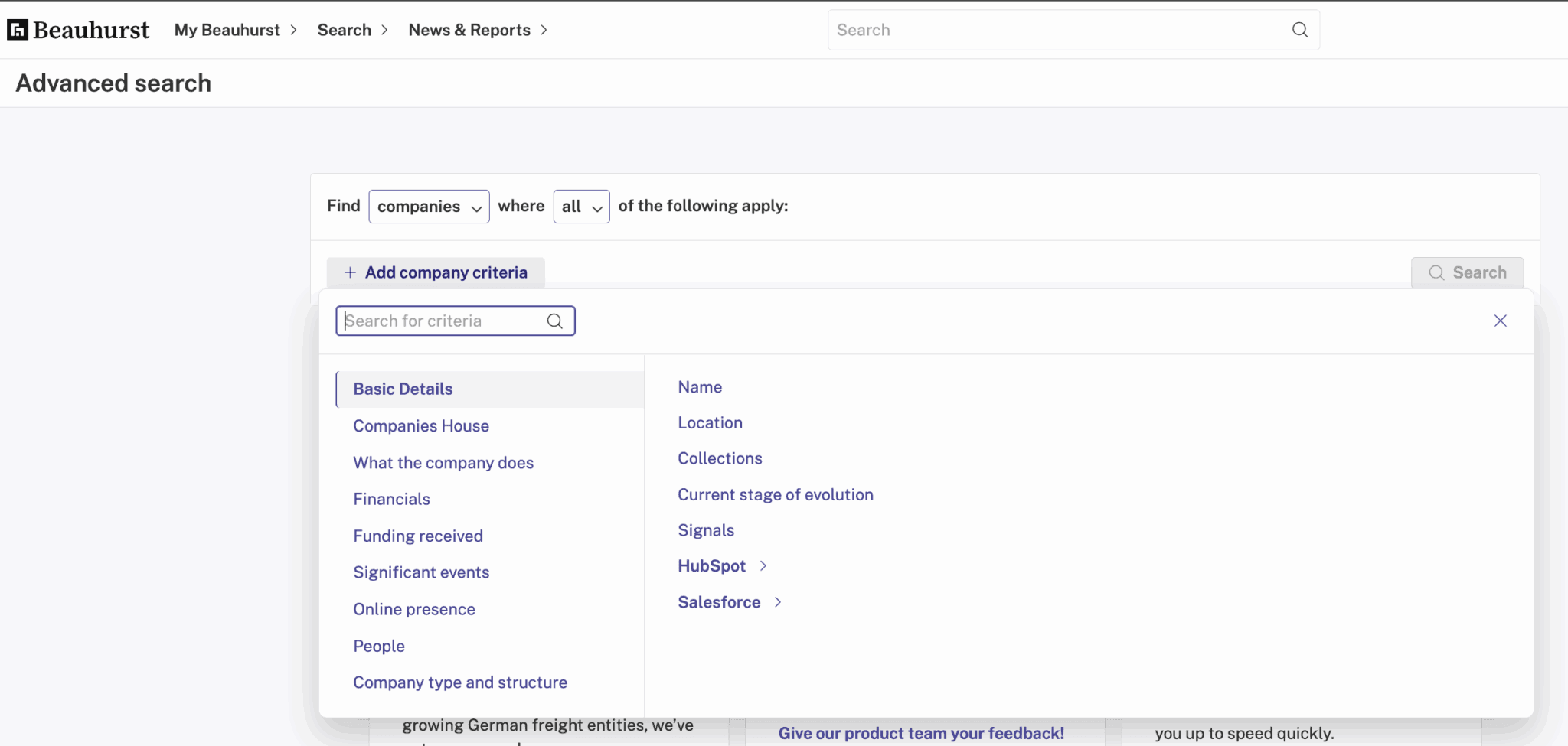
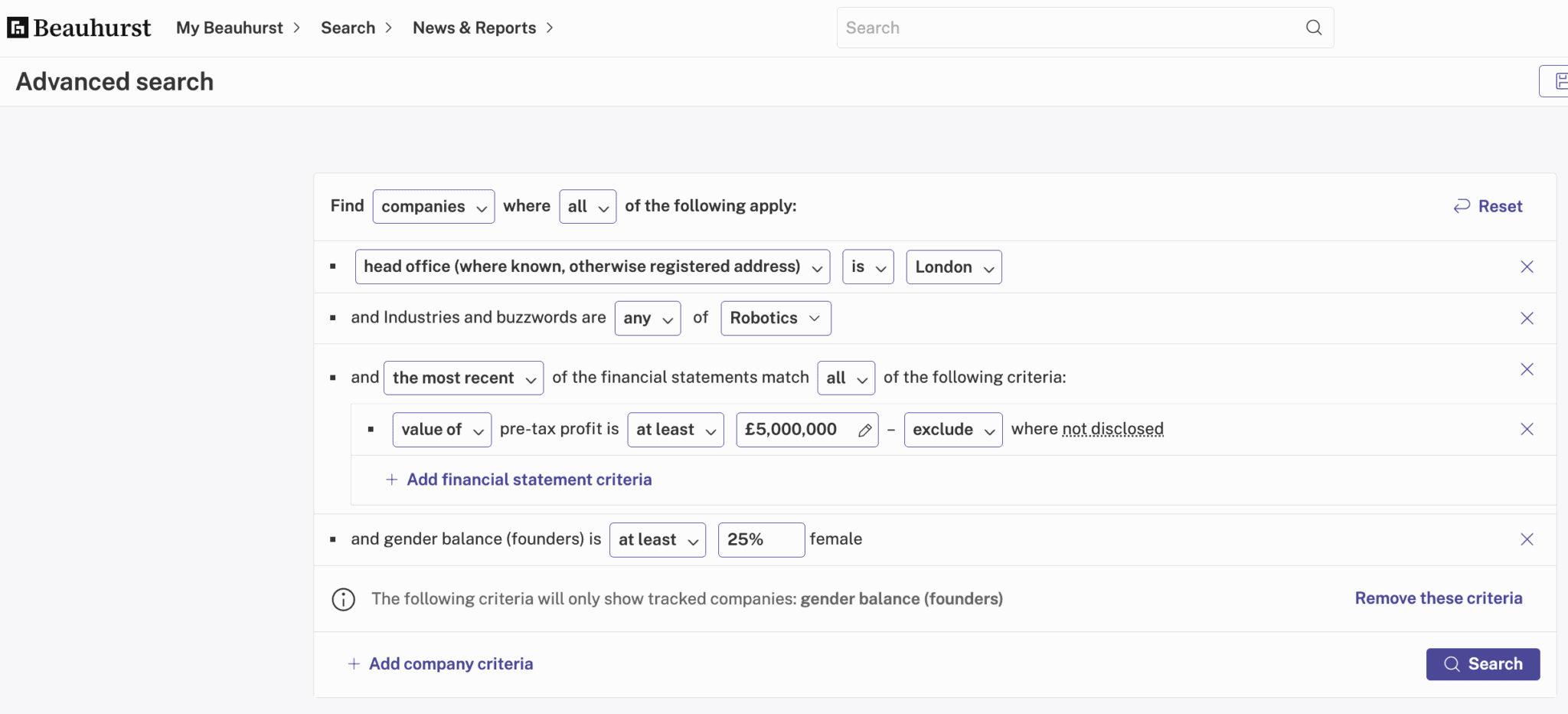
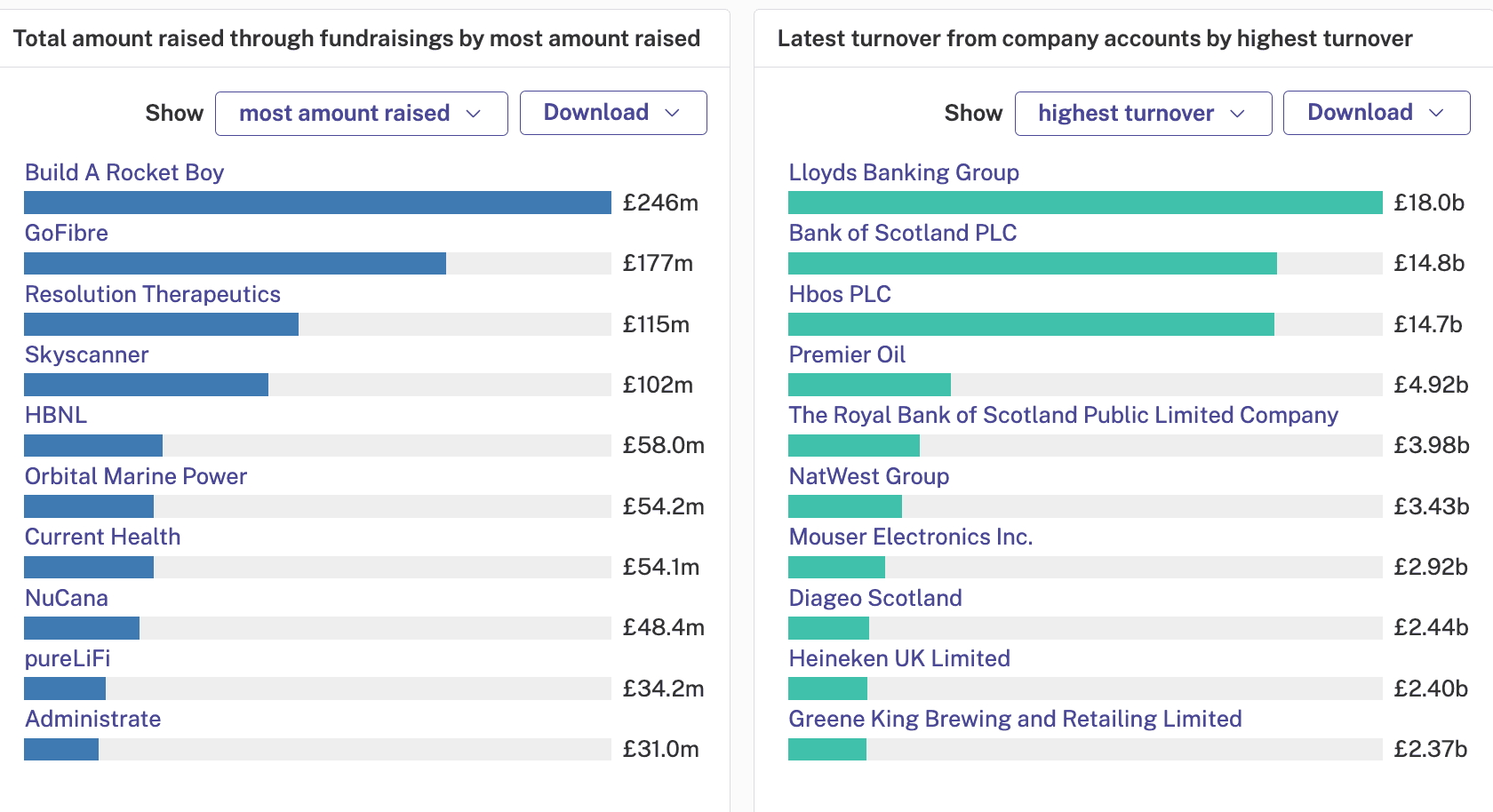
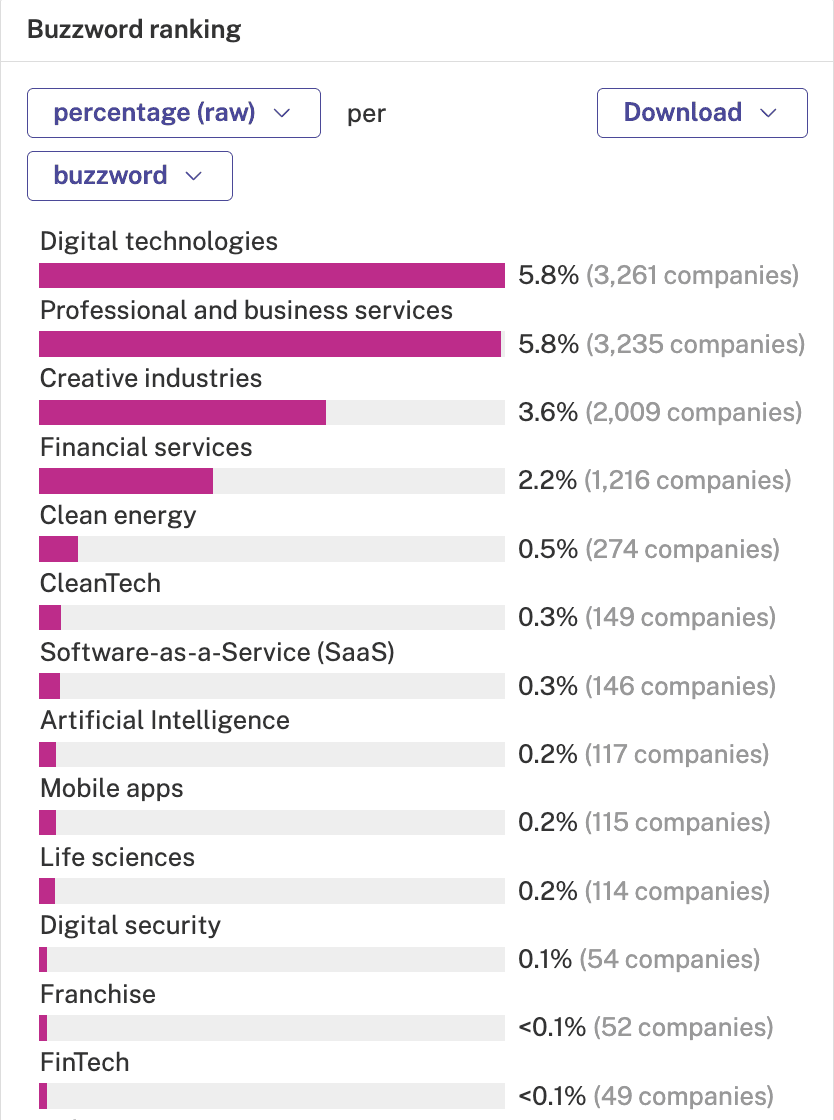
If you’re particularly interested in a local area — or in companies that meet any criteria — you can create dynamic company lists by saving your search to the “My Collections” tab in your Beauhurst dashboard.
This means that you don’t need to start a new search to be alerted to changes in your area. Simply set up a Collection, and you’ll be notified whenever a new business has entered the market, there has been a merger, or a company has received a round of funding (and more). You’ll be alerted in real time, or whenever you choose to receive the notification.
Lancashire County Council uses Beauhurst’s Collections feature to track specific businesses in the local area.
“With Beauhurst, we have access to real-time information, with a level of detail that we wouldn’t get anywhere else. And it’s very, very easy to use,” says Amin Vepari, Business Finance and Scaleup Lead at Lancashire County Council
Government databases of business information
Alongside Beauhurst, another potentially useful source of company information is government business registries. It’s often obligatory for businesses to provide some basic information, which is then listed publicly by various government offices.
As such, government registries are a great starting point for business information.
However, they won’t give you the depth of information you’d get from any of the Beauhurst platforms. Plus, every locality will have different requirements for the information they include.
That said, here are five government business sources that can be useful.
2. Companies House
Region: UK
Cost: Free
Companies House is the UK’s official registry of legal entities. All companies that are based in the UK are obliged to provide information to the database when they’re set up, and then at least once per year.
That means that if you’re looking for UK businesses, Companies House is a pretty comprehensive resource. In fact, it has the reputation for being one of the most easy to use national business registries in the world.
However, for those seeking deep, clean, standardised information, it does have its limitations. One is that companies need to update the information themselves, and Companies House explicitly says it “does not verify accuracy of information filed.”
3. Office for National Statistics
Region: UK
Cost: Free
The Office for National Statistics (ONS) is less a database than a collector and publisher of statistics.
That means it’s not searchable by business in the way that something like Beauhurst or Companies House is. Rather, it’s used more as a useful source of information on national trends and broader patterns, which it aggregates from censuses and its own surveys.
As the UK’s official government body responsible for data on business, society, and demographics, the information it provides is incredibly authoritative. And it can be used as an effective complement to other data providers.
We’ve compiled a full breakdown of the key places where Beauhurst and the ONS data differ.
4. Securities and Exchange Commission (SEC)
Region: USA
Cost: Free
The Securities and Exchange Commission (SEC) is the US government agency that oversees the stock market. As part of this role, it holds the national register of publicly traded companies.
This database is often compared to the UK’s Companies House, as it can provide in-depth information on companies that are included. However, as the SEC only includes publicly traded companies, you won’t find data on smaller businesses or those that are privately owned.
Alongside its business register the SEC regularly releases other datasets, on financial statements or other business metrics, that can inform your research. Note that these are published at irregular intervals and you’ll need to download .zip files to access the data.
5. Company registers by state
Region: US states
Cost: Free
In the US, state authorities collect information on individual businesses. But as laws differ from state to state, the information collected differs depending on where that business is located.
State business databases differ dramatically by the depth and quality of data. You can find a lot of useful information, depending on what you need. Just be aware that it is not very easy to compare companies in different states.
For instance, you can use:
New York State Corporation and Entity Business Database
California Business Search
6. European Business Register
Region: Europe
Cost: Free
Most countries in Europe have their own business registers, just like the UK’s Companies House. The European Union set up the European Business Register to centralise and standardise all the information from these databases, via the Business Registers Interconnection System (BRIS).
Currently, you can only search the system by business name, and you’ll receive basic information on companies including registered addresses.
7. Handelsregister
Region: Germany
Cost: Free for basic access; charges may apply for document downloads
The Handelsregister (Commercial Register) is Germany’s official government database for businesses engaged in commercial activity. Operated by the regional courts (Amtsgerichte), it holds legally required filings such as articles of association, changes in managing directors, capital increases, and insolvency notices.
It’s a valuable source if you’re looking for formal legal details on German companies, especially GmbHs and AGs. You can search by company name or registration number and access scanned documents and filings.
However, as with many government registers, the Handelsregister provides raw documents rather than clean, structured datasets. Information is also available only in German, which can make access difficult for non-native speakers.
8. Bundesanzeiger
Region: Germany
Cost: Free for basic use; fees apply for document retrieval
The Bundesanzeiger (Federal Gazette) is Germany’s official publication platform for mandatory legal and financial disclosures by companies. It’s where businesses file annual accounts, management reports, and insolvency notices—much like a financial reporting bulletin.
Since 2007, it has become the primary location for publishing financial statements of German companies, especially smaller private firms that are otherwise difficult to find in other registers. Filings include balance sheets, income statements, and often auditor notes, making the Bundesanzeiger an essential resource for financial due diligence.
The platform can be tricky to navigate for non-German speakers, and company searches must often be done by legal entity name. Data is provided as PDFs or HTML documents, without standardisation or aggregation — so while rich in content, it requires more manual work to extract insights.
9. Unternehmensregister
Region: Germany
Cost: Free for basic use; fees apply for document retrieval
The Unternehmensregister (Company Register) complements the Handelsregister by aggregating information from multiple German public sources — including the Handelsregister, Bundesanzeiger (Federal Gazette), and other official filings.
It serves as a broader gateway to company disclosures, including annual financial statements, auditor reports, shareholder structures, and announcements relevant to capital markets.
If you need structured financial data or want to track corporate developments, the Unternehmensregister is a more comprehensive destination than the Handelsregister alone. However, usability and standardisation remain limited compared to commercial providers, and much of the content is available only in German.
10. Infogreffe
Region: France
Cost: Free for basic searches; fees for document access
Infogreffe is the official register of French companies, managed by the country’s commercial courts (Greffes des tribunaux de commerce). It provides legal and financial information about all registered companies in France, including:
You can search by company name or SIREN number (France’s company registration number). While summaries are freely available, full documents (such as balance sheets or statutes) often require payment.
Most of the site is in French and not particularly user-friendly for non-fluent users. However, for compliance or company verification in France, Infogreffe is the go-to source.
- Company status and legal form
- Directors and shareholders
- Annual financial statements
- Insolvency filings and legal notices
You can search by company name or SIREN number (France’s company registration number). While summaries are freely available, full documents (such as balance sheets or statutes) often require payment.
Most of the site is in French and not particularly user-friendly for non-fluent users. However, for compliance or company verification in France, Infogreffe is the go-to source.
11. CRO (Companies Registration Office)
Region: Ireland
Cost: Free for basic searches; fees for reports and filings
Ireland’s Companies Registration Office (CRO) is the statutory body responsible for the incorporation and regulation of companies in the Republic of Ireland. It provides public access to:
- Company registration details
- Directors and secretaries
- Annual returns and financial statements
- Mortgage and charge filings
The CRO’s online portal is relatively accessible and includes both company and document searches. While many filings require payment to download, summaries and registration data are free to access.
Business databases for international research
Some of the best business databases aggregate data from different regions across the world. The right choice for you will depend on the specific region you are interested in, as well as the type of research you are performing.
12. OpenCorporates
Region: Global
Cost: Free
Featuring over 200 million companies in 140 geographies, OpenCorporates calls itself the largest open database of corporates in the world. The platform sources data from government business registries across the world, giving it an incredible breadth of coverage.
The platform does standardise all the information across all regions, making it really easy to navigate and compare. But if those registries have any inaccuracies, those same limitations will pop up in OpenCorporate data.
What distinguishes OpenCorporates from other databases of business information is its social purpose, which makes it a preferred tool of journalists, universities, civil society, and anti-corruption investigators. Its central goal is to boost corporate transparency, and as such it’s completely free.
13. Mergent Online
Region: US and global
Cost: Institutions pay an annual fee
Mergent Online is a database that holds information on a large range of global companies, but its focus is on publicly traded companies.
It’s based in the US and that’s where the best part of the 40,000 companies it includes are from. Alongside that, it offers users access to financial data on public companies from around the world, representing a total of 95% of the non-US global market capitalisation.
As it features profiles of both active and inactive companies, Mergent is a great source of historical data on companies and industry reports. Researchers and analysts mainly use it to access financial information on companies, including stock prices and annual reports. Plus, it provides up-to-date news on each of the 15,000 US companies it tracks.
14. Gale Business: Insights
Region: US and global
Cost: Institutions pay an annual fee
Gale Business: Insights is mainly aimed at researchers in academic contexts, although businesses can use it too. Whatever type of research you’re doing, you can access over 430,000 company profiles, plus country overviews and industry summaries.
Like many of the other databases for business intelligence on this list, Gale offers comprehensive information on company history, hierarchy, financial data, and news. Plus, if you want to compare different companies, that’s really easy through the downloadable competitive comparisons.
One of the main appeals of Gale is its UX, with interactive tools for visualising data.
15. Compustat Financials
Region: US and global
Cost: Unknown
Compustat is the database of Standard & Poor Global, the US-based corporation for business analytics. As such, the focus of the data is financial.
Its core product is its standardised financial statements for over 80,000 publicly traded companies, both in North America and globally, and both active and inactive. Plus, it includes other financial reports from these companies too, including balance sheets, cash flows, and income data.
If you need financial information on public companies, or you’re doing market research, this could be a good tool.
16. Data Axle
Region: North America
Cost: Starting from $99 a month
Previously known as ReferenceUSA, Data Axle is a data platform offering information on private companies and consumers in the United States and Canada.
It has data on 17 million businesses in North America, from the Fortune 500 to independent shops and freelancers. With data including contact information, numbers of employees, and more, it’s an impressive resource if you’re not looking just for publicly traded companies.
Data Axle also has a large team of data experts who call businesses directly to verify information and update the platform in real time.
17. Orbis by Moody's
Region: Global
Cost: Contact Orbis for pricing
Moody’s is one of the largest data providers in the world, and Orbis is its global business database. It has information on over 450 million companies and legal entities across the world, which it sources from over 170 sources. Plus, like Beauhurst, it standardises that information and makes it comparable.
For a comprehensive database of global companies, it’s a good choice.
18. Angel List
Region: Global
Cost: There are multiple products with different pricing, up to $5,000 annually
AngelList started life as an introduction board for startups that wanted seed funding, but over the years it’s become the platform where startups and investors can connect and get funding.
If you’re an investor, you can search the platform to find startups that match your investment criteria. Or you can download industry reports to discover broader startup trends.
19. Crunchbase
Region: US-based but global data
Cost: Individual plans start from $79 a month. Contact Crunchbase for enterprise plans
While Crunchbase claims to be a database for all private and public companies, most of its users make use of its data on tech companies in particular.
It’s primarily a prospecting tool, where businesses and other people can find information on early-stage startups and other companies, plus who works in each company. All that information is crowdsourced, meaning it’s supplied by the users themselves — which can sometimes lead to inaccurate information.
Crunchbase also provides reports on startups, industry news, and relevant trends by region.
20. CB Insights
Region: Global
Cost: Contact CB Insights for pricing
CB Insights claims to have the world’s largest dataset on technology companies and trends. It’s used by some of the biggest companies — including Microsoft, IBM, and Wells Fargo — to find information they need to build relationships, understand markets, and decide who to fund or to acquire.
Much of this data is provided by startups themselves, which CB Insights asks for information through its “Analyst Briefing” program. But it complements that information with multiple other data sources.
21. e27
Region: Asia
Cost: Unknown
e27 is the specialist database for business information on Asian startups. If you’re looking for data on the tech ecosystem in this part of the world, e27 may be your best resource.
At the time of writing, e27 had almost 37,000 startups listed on its platform. All of them are searchable and comparable by location, industry, funding, and more.
Then, once you’ve found a specific company that matches your criteria, it’s easy to connect with them too. The platform will link you to the startups’ social media sites including LinkedIn.
Company information databases for lead generation (only)
One common reason why professionals look for databases of company information is for lead generation. Some databases are built only with this use case in mind, but the data quality is hit-and-miss.
(Note: You can find contact details for key personnel on any of Beauhurst’s platforms, too).
22. Company Check
Region: UK and Ireland
Cost: Prices start from £50 + VAT annually
One well-known platform that’s used for lead generation is Company Check. With data on over five million companies in the UK and Ireland, it’s a reasonably comprehensive source of business information.
Users can access financial information on businesses too, as well as business credit checks for purposes of due diligence.
23. ZoomInfo
Region: Global
Cost: The five different products have different prices. Contact ZoomInfo for details.
ZoomInfo is one of the largest databases of company contact information. It works like a search engine, where businesses can search for prospects and their contact information. The platform sources its data from multiple providers, alongside a team of researchers as well as community contributors.
This way, it tries to keep its data as up-to-date as possible. Although this tool serves its purpose by providing contact details for potential clients, it lacks accompanying company data. That’s where Beauhurst comes into play, enabling sales teams to identify the most promising accounts to prioritise their efforts.
24. Vainu
Region: Nordics and global
Cost: Plans for Nordic data only start at €4,200. Plans for global data start at €12,000.
Vainu is a B2B data platform that’s designed to speed up customer acquisition. You can access Vainu’s broad range of company data directly through the website, through your CRM, or through a browser extension. You can find the companies that are most relevant to you by searching through multiple overlapping criteria.
The company is based in Helsinki and has focused on Nordic companies, making it the most comprehensive database in the region. However, more recently Vainu collects data on companies globally.
25. Cognism
Region: Global
Cost: Contact Cognism for pricing details
Cognism is another database of business contact information. It claims to have the largest dataset of European companies, as well as the richest collection of mobile phone details in the US. The database allows you to search for companies by location, industry, size, and more, allowing you to identify your specific market. One of the things that makes it stand out is that it verifies key contact details.
Beauhurst complements this tool by providing the missing company data component, allowing sales teams to make informed decisions on which accounts to prioritise, while still utilising the tool’s functionality to find contact details for potential clients.
Beauhurst: The database for company information in the UK and Germany that you can trust
In this guide, we’ve covered 25 databases of company information, for different use cases, regions, and industries. Depending on your needs, you’ll find the perfect fit.
If you’re looking for a premium database of rich, comprehensive, searchable, and comparable UK and German company information, Beauhurst is your best choice. With a Beauhurst subscription, you can:
- Access the deepest information available on all UK and German companies
- Search for companies and people by region, industry, fundraising, and many other overlapping criteria
- Track the performance of regions or companies in real-time
To see the platform in action, take a two minute tour of the data — or to speak to a member of the team, simply book a demo to find out how Beauhurst can work for your organisation.