Brexit and Foreign Investment into UK Companies

Words Callum Newton

Brexit and Foreign Investment into UK Companies

How Brexit Reshaped Foreign Investment into UK Companies

Cast your mind back. Leicester City are Premier League champions, Drake’s “One Dance” is still number one in the UK charts and Jon Snow has defeated Ramsay Bolton at the “Battle of the Bastards” in Game of Thrones. It’s 23rd June 2016, and Britain has just voted to leave the European Union (EU).

The country had been through one of the most bitterly divisive political campaigns in living memory, one whose consequences still reverberate to this day. At the centre of both campaigns were arguments about how our new relationship with Europe would impact investment into UK companies.

In one corner “Vote Leave” insisted the UK would “continue to attract significant foreign investment” on the basis of language, common law, time-zone and its tax system rather than EU membership. In another, George Osborne from the Remain campaign claimed “Britain would be permanently poorer if it left the European Union. Under any alternative, we’d trade less, do less business and receive less investment”. Barack Obama also famously claimed post-Brexit Britain would be “back of the queue” for any trade deals.

But who was right? A decade on from the referendum, the Beauhurst Insights team wanted to measure what happened to foreign equity investment into UK private companies and test whether either campaign’s claims were correct.

Foreign equity investment into UK companies since Brexit

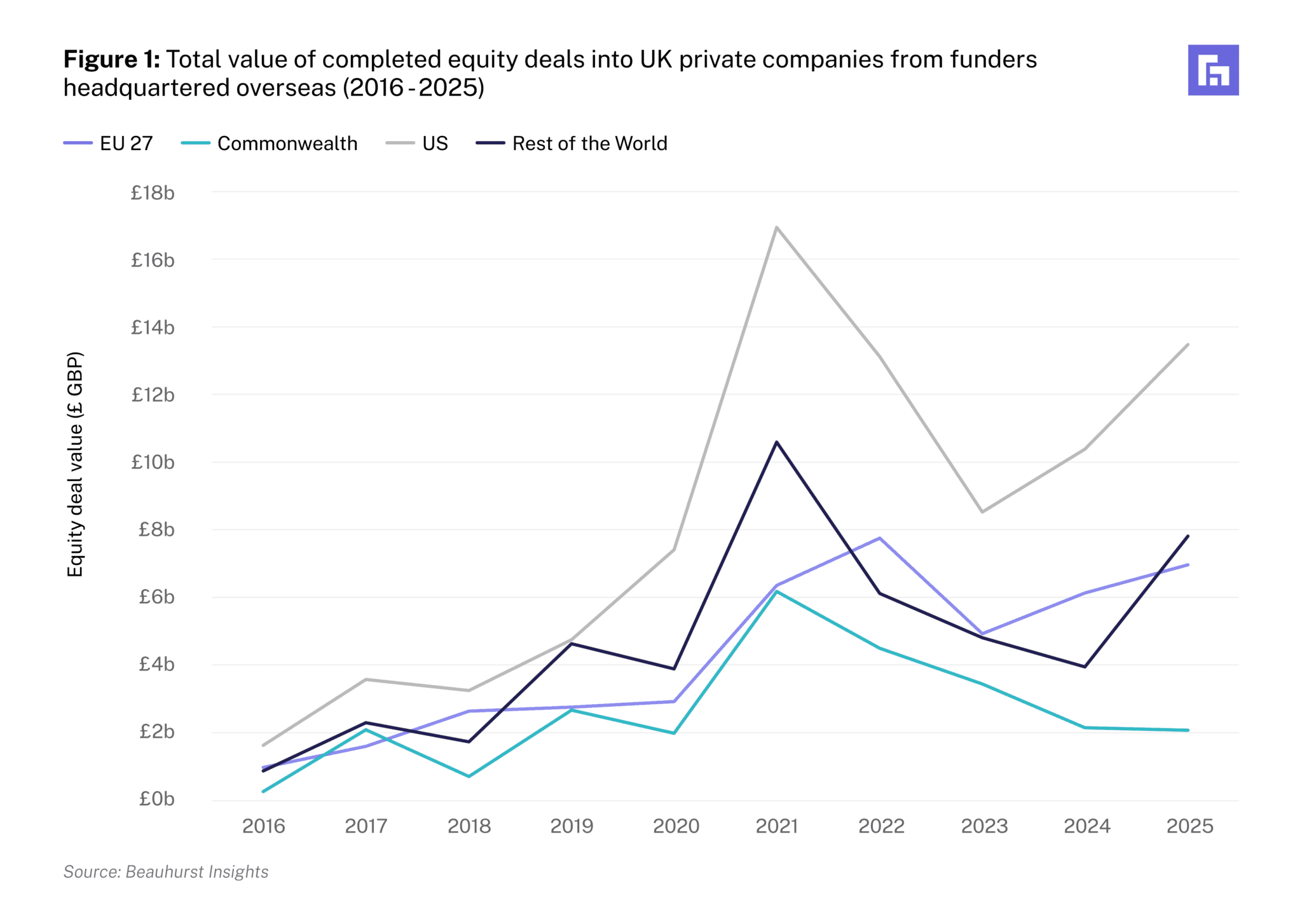
Despite the warnings, equity investment into British companies did not collapse after Brexit. Beauhurst’s data shows UK firms are now attracting more equity funding from EU investors than they were before the referendum. As Figure 1 shows, the total value of completed equity deals involving EU-based investors grew roughly sevenfold over the measured period, from around £985m in 2016 to just shy of £7bn in 2025. That broadly tracks a wider global rise in equity investment, with US-based investors remaining the single largest source of capital into UK private companies over the last decade.
line chart 1

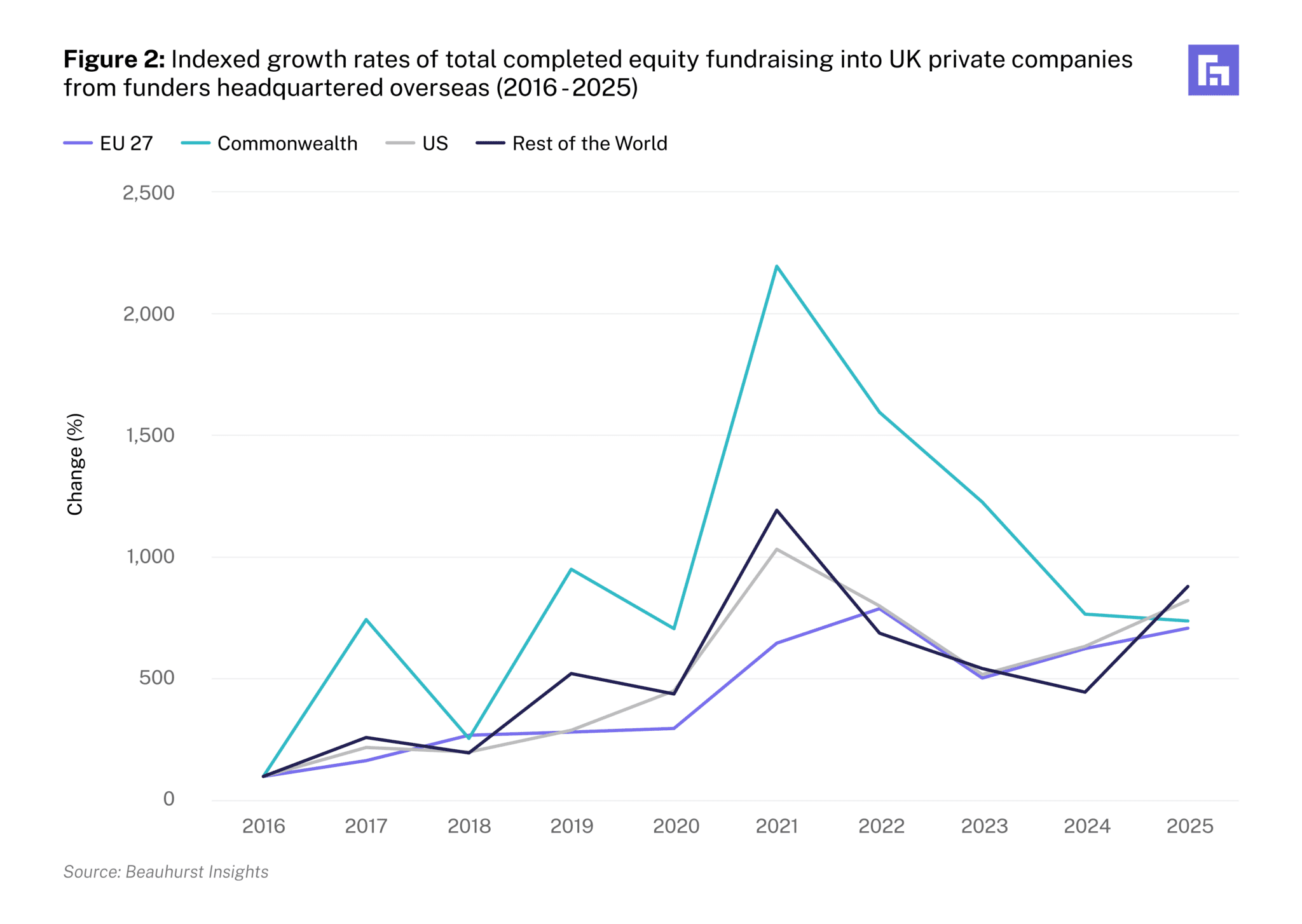
Two caveats sit behind that headline number. First, although the total value of EU investment rose, it grew at the slowest rate of the four cohorts we measured. As Figure 2 shows, equity funding from EU 27 members consistently lagged behind that from Commonwealth countries (e.g. India, Canada and Singapore), the “Rest of the World” (e.g. China, Japan and the UAE) and the United States. The Commonwealth posted the fastest growth rates for much of the measured period (particularly during the COVID-19 pandemic) though the gaps between cohorts narrowed sharply by 2025.

line chart 2

Second, the EU 27’s share of foreign equity investment into UK private companies has declined. The bloc accounted for around 25% of foreign investment in 2016, falling to just 15% at the height of the pandemic. That share has since recovered to 22% in 2025, which is better than its pandemic-era low, but still below pre-Brexit levels. The ground the EU has ceded has been picked up by Commonwealth and “Rest of World” investors, whose combined share of UK foreign equity has crept up over the same period.

However, the picture painted by these two points isn’t quite the sunny uplands many “Brexiteers” promised. Over the period, total Commonwealth investment amounted to only a fraction (around 60%) of what EU investors put into UK private companies. There may be some evidence that Britain has become more attractive to Commonwealth and other global capital, but EU investors remain by far one of the most important source of foreign equity into UK businesses.

How EU investors diverged: France, Germany and Ireland

Throughout the Brexit negotiations, the EU’s chief negotiator Michel Barnier consistently invoked the phrase “unity of the 27” in an attempt to signal the bloc would speak with one voice and bargain from a position of strength. The data however tells a slightly different story. Despite that united front in Brussels, EU investors reacted very differently to the referendum result, with some doubling down on the UK and others heading for pastures new.

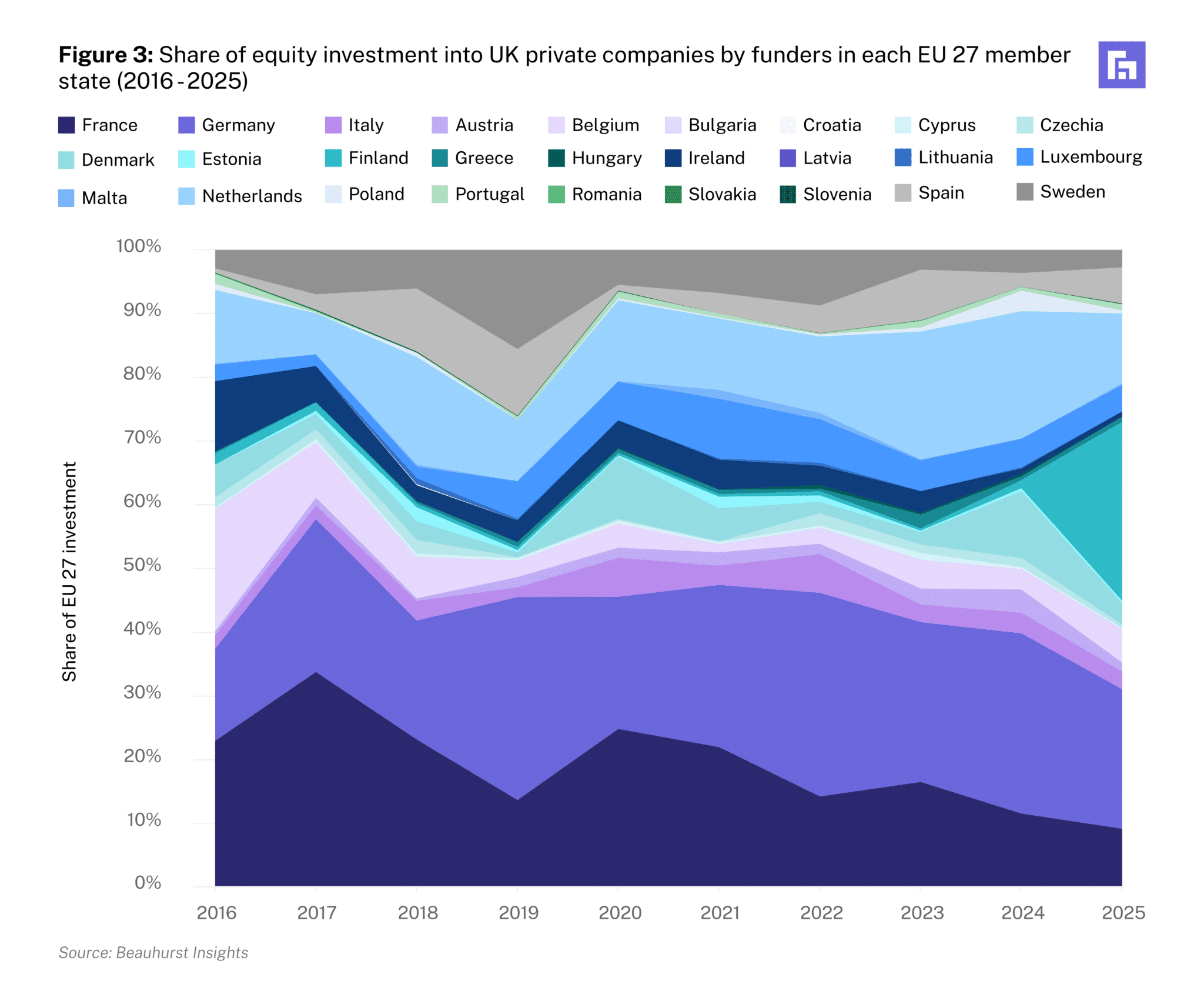
Figure 3 illustrates this point. In absolute terms France and Germany remain the largest EU investors in UK private companies, but the two halves of the Franco-German motor have moved in different directions. French investors accounted for 23% of EU investment into UK firms in 2016, by 2025 that share had shrunk to 9%. Over the same period, the German share rose from 14% to 22%. There are likely several reasons for this, ranging from Macron’s “Choose France” strategy pulling French capital home, sustained Franco-British political tension over fishing, the Northern Ireland Protocol and AUKUS, and the German Mittelstand’s long-standing appetite for strategic stakes in UK firms – appetite that may well have sharpened as a weaker pound made British assets cheaper for euro-denominated buyers.

Whatever the cause, investors clearly did not act with unity, regardless of what Brussels said. The picture from Beauhurst’s data is genuinely mixed. Some countries seized the moment: Denmark’s share rose to 10% of EU investment at the height of the COVID-19 pandemic, and the Netherlands climbed to 20% during the post-COVID rebound. Whereas others retreated sharply. Irish investment collapsed from 11% of the bloc’s total in 2016 to just 1% by 2025. A rising tide may lift all boats, but it’s far from clear that the UK will be able to win back its lost EU backers once the current cycle of deal-making cools.

Brexit and foreign investment: what the data shows

So who was right? The “Brexiteers” can claim a bit of a win. The UK has continued to attract significant foreign equity investment in the decade since 2016 (including from inside the EU) undermining claims that Brexit would trigger a collapse in foreign investment into British businesses.

But the data doesn’t let “Vote Leave” off either. EU equity investment grew, albeit more slowly than every other cohort we measured. The EU 27’s share has shrunk, and the European investor mix has reshuffled – France retreating, Germany advancing, Ireland vanishing, Denmark and the Netherlands surging – in ways that look more like adjustment to a costlier relationship than the clean break the more radical wing of “Vote Leave” argued for.

In short, Brexit hasn’t broken British firms’ ability to attract foreign capital (especially European capital). There is a fair case to be made about opportunity cost (could the UK have raised more had it voted Remain?), but the data is clear on one point: a full decoupling from Europe has not happened, and the “Singapore-on-Thames” vision has not materialised. Both campaigns turned out to be more right (and more wrong) than they were willing to admit at the time.

Want to discuss the data? Drop me a message: callum.newton@beauhurst.com

Subscribe to the Beauhurst Insights Substack

Data-led analysis of the UK’s private companies, straight to your inbox.

Subscribe
Discover our data

Get access to unrivalled data on all the companies you need to know about, so you can approach the right leads, at the right time.

Book a demo today to see all of the key features of the Beauhurst platform, as well as the depth and breadth of data available.

An associate will work with you to build a sophisticated search, returning a dynamic list of organisations that match your ideal customer profile.