Is UK Equity Investment Really in Retreat?

Words Callum Newton

Is UK Equity Investment Really in Retreat?

Last month the Beauhurst Insights team published our annual ‘The Deal’ report with our partners at Mercia Ventures showcasing the latest equity investment trends of UK private businesses. It paints a mixed macroeconomic picture. The total number of equity deals is down, but the number of first time deals are up. Overall UK businesses secured £24 billion through equity investment in 2025, up from £23.2 billion in 2024. However quarterly levels of investment are yet to return to pre-election levels.

To critics, these trends point to an alleged lack of confidence in ‘UK plc’. But these detractors are missing something crucial that’s going on under the surface, a huge reallocation of investment hyper-focused on the UK’s high growth industries. In this article I’m going to dig a bit deeper, because the real story isn’t how much money is being invested – it’s where it’s going.

Where UK equity investment is concentrating

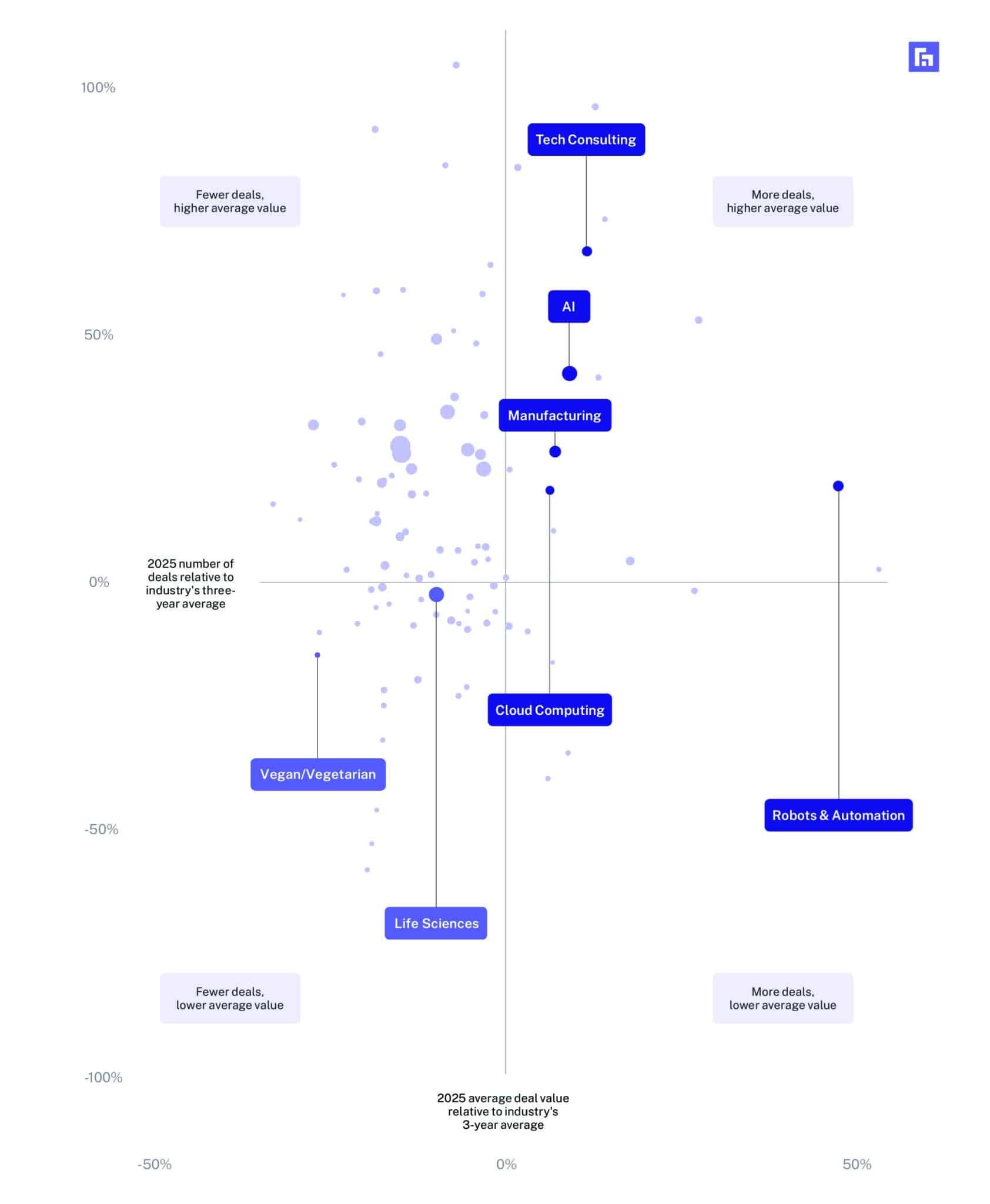
The reality is investors are becoming increasingly selective. Figure 1 outlined below from The Deal, compares deal volumes and average deal sizes across Beauhurst’s top 100 recipient industries against their three year averages. Last year, 79 of these sectors recorded fewer deals, but 50 of those also saw higher average deal values over the same period. This includes leading areas such as CleanTech and FinTech which account for less than 3% of British scaleups but sit at the heart of the UK’s Modern Industrial Strategy. Together this suggests a more selective investment climate, with investors concentrating capital into fewer, higher-growth opportunities.

But two other trends are also unfolding in tandem. The upper-right quadrant of Figure 1 shows industries such as AI, robotics and cloud computing securing both more and larger deals than their prior three year averages, ultimately bucking the wider national trend of selectivity. This may be emblematic of the apparent ‘AI bubble’ – the alleged overvaluation of tech firms which may be leading to another ‘dotcom’ level crash. Regardless, AI and British tech are in-fashion and it seems investors are still willing to pay-up for the strongest prospects.

The reverse is also true. Investment is often cyclical, and sectors that fall out of favour often see both deal volumes and values decline. Two seemingly unrelated sectors – life sciences and veganism – neatly illustrate this point. Investment in life sciences skyrocketed during the COVID-19 pandemic. Life sciences investors are often constrained by sector focus, and last year the industry saw deal volumes fall by 8% and values decline a further 2% relative to its three-year average, as investment tapered off with the easing of infection risks. On the other end of the spectrum, veganism reached a cultural zenith in the early 2020s with a flurry of investment to match consumer demand. Yet in 2025 vegan-focused firms experienced sharper declines, with a 23% drop in the number of deals and 15% in deal value.

Figure 1: Deal volume and average value relative to industry’s three year-average (2023-2025)
scatterplot chart 1

Capital rotation: which investors are driving the shift

The rise and fall of investment trends is inevitable. What some describe as ‘risk aversion’ is often little more than a temporary recalibration of thematic priorities. But who is actually driving this shift – and is it right to treat all investors as the same unanimous bloc?

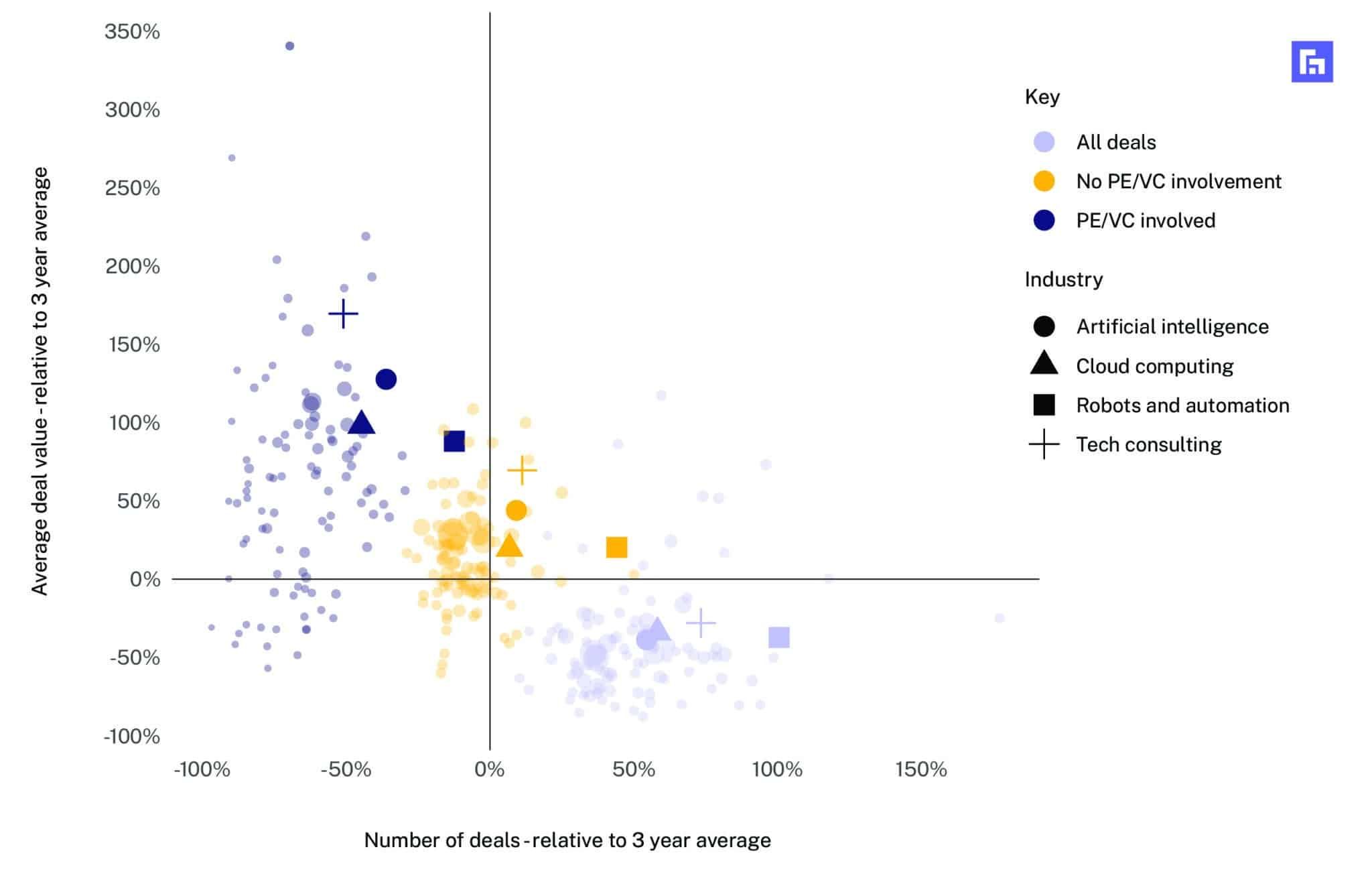
The short answer is no. Different fund types are responding very differently to the changing dynamics of the UK’s equity market. As shown in Figure 2, the trend is being disproportionately driven by Venture Capital and Private Equity firms, which are completing fewer deals but at a higher average value. To put this in context, no industry recorded more VC/PE-backed deals in 2025 compared to its prior three-year average.

The opposite pattern holds for non-VC/PE activity. Most industries saw a greater number of smaller deals, and every sector recorded more non-VC/PE-backed transactions than its historic average – including from angel networks and institutional investors (e.g. Banks, Asset Managers and SWFs). This divergence is particularly evident in the “double positive” sectors shown in Figure 1, such as AI, robotics and tech consulting. In each case, VC and private equity investors drove up the average deal size, while non-VC/PE funders spurred the number of deals.

Figure 2: Distribution of deal volume and average value relative to industry’s three year-average by funder composition (2023 – 2025)

scatterplot chart 2

This issue disproportionately affects parts of the economy that are critical to breaking Britain’s growth “doom loop.” It is no accident that technology sits at the heart of the UK’s Modern Industrial Strategy. London has been a global centre of commerce for centuries, and Britain – once the cradle of the Industrial Revolution – has been at the forefront of world-changing innovations, from the jet engine and penicillin to the World Wide Web.

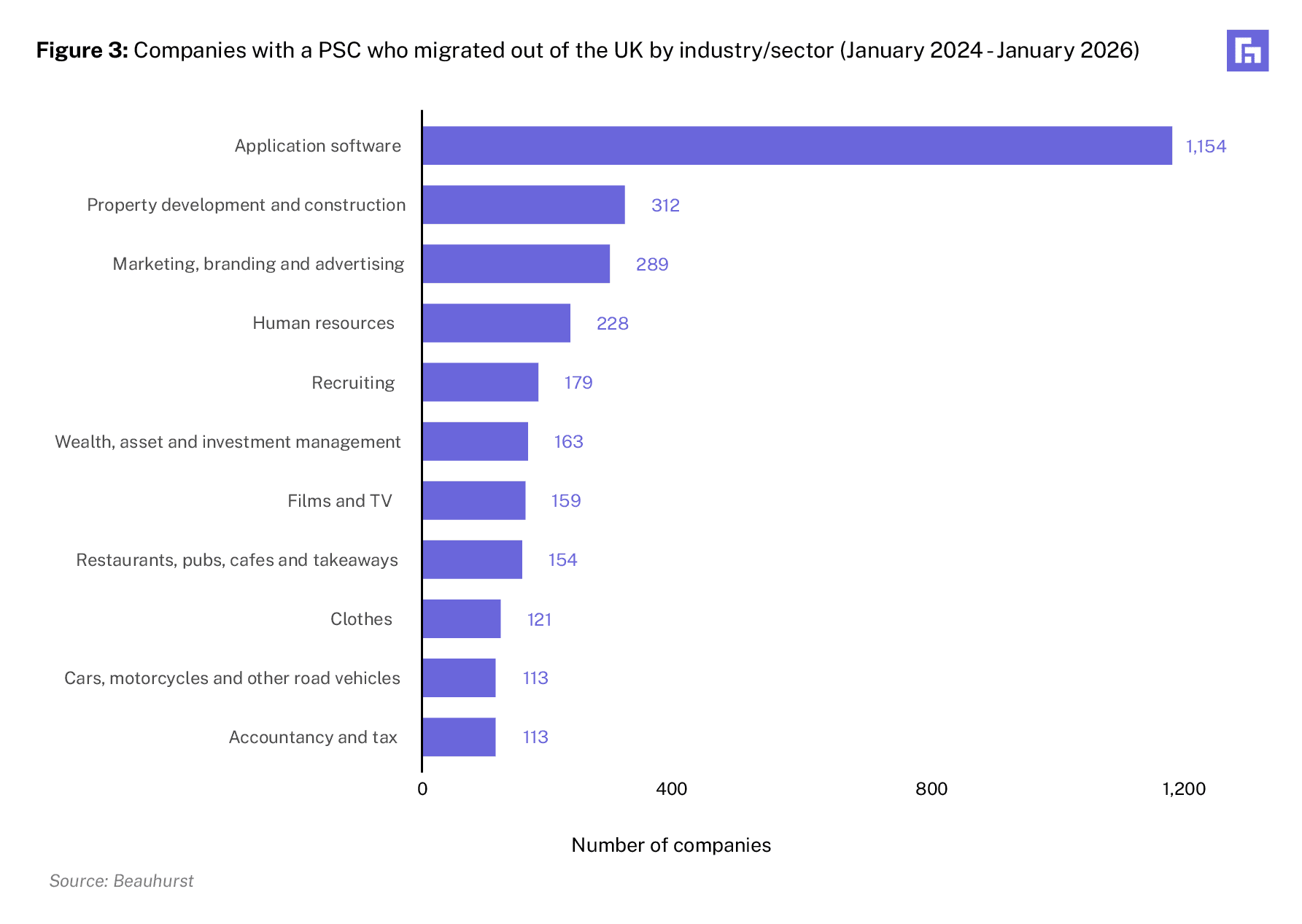
Unfortunately, the sector has been particularly exposed to this issue. Software businesses alone account for over 10% of companies where a PSC has relocated overseas in the past two years. This is especially significant given that application software firms generate 7.6% of national business turnover and account for 23% of Britain’s high-growth companies.

bar chart 3

So what does this all mean for the future of the UK’s equity investment landscape. Mercia Ventures MD Will Clark was absolutely right to point out that it would be “easy” for commentators to look at the macro-level data and claim investors are becoming increasingly cautious. But what’s actually happening is the UK equity market is “not retreating so much as refining its focus, and that founders remain firmly at the centre of that recalibration”.

Taken together, the data tells a very different story from the prevailing narrative of retreat. Capital hasn’t left the market – it has simply become more deliberate. Investors are concentrating resources into sectors and firms with the clearest growth prospects, while stepping back from areas where momentum has cooled. Far from signalling a loss of confidence, this reflects a market allocating capital with greater precision and discipline. In other words, this isn’t capital flight, but capital rotation: fewer deals, bigger bets, and a sharper focus on where growth will likely emerge. The art of the deal, it seems, is becoming the art of discernment.

Want to discuss the data? Drop me a message: callum.newton@beauhurst.com


Subscribe to the Beauhurst Insights Substack

Data-led analysis of the UK’s private companies, straight to your inbox.

Subscribe
Discover our data

Get access to unrivalled data on all the companies you need to know about, so you can approach the right leads, at the right time.

Book a demo today to see all of the key features of the Beauhurst platform, as well as the depth and breadth of data available.

An associate will work with you to build a sophisticated search, returning a dynamic list of organisations that match your ideal customer profile.