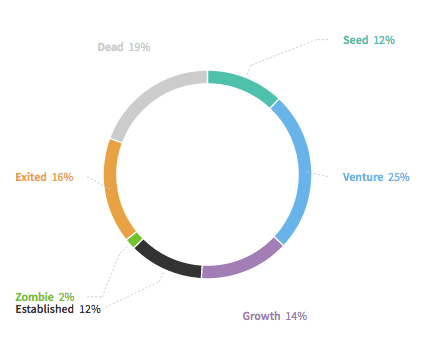
Each year, Beauhurst revisits a cohort of British startups who raised equity finance in 2011. 2010 onwards marks the real start of the UK’s startup movement – as our data has shown, VC activity in this country over the past nine years has shown rapid year on year growth, in large part buoyed by the growth of Britain’s fast-maturing tech industry.
1545 British startups raised equity finance in 2011, providing a good sample size, and it’s now been eight years since these funding rounds. The venture capital life cycle for a young company is fluid, and prone to frequent exceptions. As we reported last year, many young companies now seem to be putting off IPOs in favour of larger late-stage private deals. However, the exit horizon for a VC investment is still generally considered somewhere in the 8 – 12 years mark. Our 2011 sample therefore falls nicely into the lower bound of a VC’s preferred time to exit.
The overall picture is mixed. 19% of these businesses have since died. This figure goes up to 21% if you include companies classed as “zombie”, i.e. those displaying passive signs that they have gone out of business. At first glance this seems to dispel the oft-quoted claim that “90% of all startups fail”. However, it’s important to remember that our sample only looks at businesses that have already raised finance, and doesn’t include the many startups that will fail before reaching their first funding round. That said, the figure still seems positive, for the VC due diligence process if nothing else.